[Letters and Correspondence 1833—Rome]
On board the 'Hermes'—Corfu
{281} On board the 'Hermes,' Corfu: January
1, 1833.
A happy New Year to you all at home. Ever since we got here it has been
pouring furiously, and almost incessantly, and the accommodations are so
suspicious on shore that as yet we remain here on board ...
There are passages in the following letter to his sister which show a reaction from the tension under which Mr. Newman's mind had been held by the scenes around him.
TO HIS SISTER HARRIETT
On board the 'Hermes,' Corfu: January
2, 1833.
This morning is the first tolerably clear day we have had. Monday and
Tuesday have been days of incessant violent rain. On going on deck I was
really astonished at the view. Even today is not a bright day, so I have
a poor idea what the view really is; but I see quite enough: high
mountains of a brilliant white or slate colour, folded in long plaits
like a table-cloth artificially disposed along a rising and falling
outline, without crease or rumple; rocks of a rich brown, looking so
near that you think you could touch them, and others of a pale sad
colour, like Malta. We are to have a good ride today; the roads are said
to be excellent, and soon dry. It is an overpowering thought to
recollect that the place looked precisely the same in the times of Homer
and Thucydides, as being stamped with the indelible features of the
'everlasting hills.'
Here that famous faction fight began which eventually ran through Greece; and what a strange contrast was the scene last night at the Palace—the ball on the anniversary of Constitution Day—at the magnificent palace of a nation in the time of Thucydides not merely barbarous, but unknown. Dresses, novel to them, and unbecoming, but rendered fashionable as being the garb of their masters, soldiers in a like costume, and Greek names and faces in the midst of them all; all mixed up and dancing together, as if it were the most natural thing in the world. Let me set it down in my books, a proposition settled and indisputable, that no change is so great as to be improbable.
January 4.
I have a great deal to say, but fear I shall forget it. No description
can give you any idea of what I have seen, but I will not weary you with
my delight; yet does it not seem a {282} strange paradox to say that,
though I am so much pleased, I am not interested? That is, I don't think
I should care—rather I should be very glad—to find myself suddenly
transported to my rooms at Oriel, with my oak sported, and I lying at
full length on my sofa. After all, every kind of exertion is to me an
effort whether or not my mind has been strained and wearied with the
necessity of constant activity, I know not; or whether, having had many
disappointments, and suffered much from the rudeness and slights of
persons I have been cast with, I shrink involuntarily from the contact
of the world, and, whether or not natural disposition assists this
feeling, and a perception almost morbid of my deficiencies and
absurdities—anyhow, neither the kindest attentions nor the most
sublime sights have over me influence enough to draw me out of the way,
and, deliberately as I have set about my present wanderings, yet I
heartily wish they were over, and I only endure the sights, and had much
rather have seen them than see them, though the while I am
extremely astonished and almost enchanted at them.
The bad weather has almost left us. On Tuesday the rain was so violent and the sea so rough, we thought we should not be able to land for dinner. We managed it—not without a drenching—and went in the evening to the Palace, where almost the whole island was assembled. We were told we should see a great variety of costumes; but the rain kept the country people away, and there were not above ten Greek dresses in the room. There is an affectation among the people of the English costume. The most remarkable sight was Madame M. (the late Mrs. Heber) and her husband in Greek dresses. He is certainly a striking-looking man, with a fine profile, and an expression of benignity and dignity. The rooms are magnificent. We had dined at the Artillery mess, and found the officers the same intelligent gentleman-like men as they were at Gibraltar. The Artillery, I believe, is superior to the rest of the army. The mess is the best appointed, they having the advantage of waggons, &c., to carry their things about with. Certainly they live in sumptuous style. Major Longley (brother of Longley of Harrow), who is resident at Cerigo, was our host, and Archdeacon Froude had letters to Colonel Armstrong. Our reception was an amusing contrast to our entertainment at the Commander of the Forces, Sir Alexander Woodford's, with whom we dined the two last days. He has been extraordinarily civil, and even asked us a third tune—Saturday. This company was entirely military; a {283} number of dandy officers, aides-de-camp, &c., brimful of the indifference which is now the fashion. At dinner, a formidable round table neither top nor bottom, Greeks to wait, a service of plate, dishes handed round, no conversation. However, I made a slight acquaintance with one of these, who seems to have good about him. He interests me, because in a measure I enter into his state of mind. He has a good deal of talent and taste—a German scholar, passionately fond of Weber's music—feeling his superiority to the generality, who follow base pleasures, yet (seemingly) substituting refinement for religion. He has kindly undertaken to get me some Greek airs transcribed, which I mean to send you.
On Wednesday and Thursday we took rides about the country, the first of twenty miles, the next of thirty; and how am I to speak of their strangeness? There was nothing to remind you of England but the high roads, which are capital, on Macadam's plan. Olive is nearly the only tree; there are forests and parks of them, through which the road winds. The leaf must be monotonous in summer, but it is beautiful now. The tree is very like a willow, such as in Christ Church Walk; the trunk and branches being more graceful and white. It does not grow to a great size commonly. The trunk separates into parts when it is old. Often it presents a network appearance, as honeycombed. The tree, I think, never dies; as one portion goes another shoots out. However—(Monday, January 5, having left Corfu; Ithaca in sight)—the olive in Corfu is of no great age. They were planted in Venetian times, a great many of an inferior kind. There is great uncertainty in the right of property in them. A tree is sometimes divided among two or three persons—the divisions of land are vague. The olive requires scarcely any cultivation, except care that the roots are not left bare, which happens in a rocky soil with occasional heavy rain and steep banks. There is very little corn grown, Indian corn instead; the land is too swampy for the former. Sir F. Maitland attempted drainage, but failed.
But I have digressed from my ride. The beautiful cypress was another strange sight. It stands when grown in groups of two or three, shooting up in black graceful spires amid the olives. The shaft is used for the masts and yards of the lateen-rigged vessels. It is beautifully straight. The orange-tree, again, is in full fruit, with its bright-polished leaf; I did not observe many wild, and none that were wild with fruit. The fig is not in leaf. We had a loss, too, as regards the colours {284} of the ground, which in spring, we were told, is covered with a profusion of wild flowers (I have got the seeds for my Mother [Note 1], but not of the most striking flowers). Even at this season the brushwood and hedgerows are beautiful. The myrtle, which is profusely spread over the country, is of a rich brown-green. The vines are cut down at this season, and look like stumps. There is a dwarf holly, too, and the arbutus, all evergreen; here and there the cactus and the aloe.
The moving portion of this strange scene was as strange as the trees themselves. Peasants on horseback (mules are scarce and fetch a high price), two persons on one, with their legs on one side and their load before them; they have few carts—I didn't see one market-cart—flocks of goats, sheep, not woolly like ours, but with soft fleeces like hair, flowing, and with queer graceful little bodies; cows, like wild cows, with strange necks and backs, and of a dun or iron-grey colour.
The landscape itself is beautifully varied; finely-formed heights, intersected with plains, deep ravines, villages, or rather towers, perched up upon the hills. Both days we digressed from the road, cutting across country. In that way we had a specimen of what travelling is in Greece; you may cut across almost anywhere, but for the most part at a walk. You descend by beds of rivers, you cross rocks. How horses go I can't conceive; fancy riding over the ruins of a brick wall, and you will have an idea of it, except that the stones are not sharp. The rock here is chiefly limestone, and the weather polishes it. The steps up to the houses are all marble—strange at first sight. The villages in a deplorable condition, and seem once to have been more important than they are now. The people are marvellously idle. In Corfu the streets swarm with men doing nothing; and the roads are full of them. In a village where we stopped, a horse having lost a shoe, a collection of idlers of all ages came round us; all dirty and uncombed. The children are fine-looking, and some of the men; the women keep indoors. Their bread is very fair (the corn comes from Poland and the Black Sea through Odessa); though in these parts, from Spain to Corfu, they leaven it. This gives it a sour taste when it is old. The population of Corfu by itself is said to be 40,000, which is almost incredible, though the statement comes from one who ought to know. Our rides across country have given me some definite notion of the state of travelling in Greece in the {285} times of Thucydides, &c. (also I have some drawings). It is astonishing I should have so long read about a country without realising it, and I am amazed how it ever became one country; how its inhabitants ever had intercourse with each other, how they ever could go to war, &c. &c.; for it is one heap of mountains thrown together in the wildest way conceivable.
The town of Corfu is very picturesque in the Venetian style. The churches are very numerous—as in Oxford (they say) there is a pot-house every ten houses, so of the churches here. Dissenters are unknown in the Greek Church. There seems much superstition here. On Saturday we saw the church and body of St. Spiridion, who was one of the Nicene Fathers, though doubtless it is not his body. He is the patron saint of the island; each of the seven has its own. The churches are Venetian; but why it was that the Venetians extended the Greek communion I have not made out. St. Spiridion's is small, but handsomely fitted up, though not so much more so than a country church which I by chance went into. I was surprised; the two were so much alike in arrangement and decoration. A number of paintings in gilt frames, not badly executed, the subject the history of Genesis and the Last Judgment; large silver lamps; stalls, like in cathedrals, for the chief persons and the infirm—for the Greeks stand in prayer for the most part. At the east end a number of pictures in parallel niches—apostles, prophets, &c. Lower down, our Saviour, the Virgin, St. Gregory, &c., Moses. A door opens into what in England is called the chancel—where seems to be the high altar—the Consecration, I suppose, being private; in St. Spiridion the saint's silver tomb and body.
The Greek clergy of these islands, as of the Morea, are of a lower rank, as our Methodists. They are said to be very ignorant, but moral in their lives. They interfere little, or not at all, with their flocks, who pay them their offerings and receive the rites of religion as a quid pro quo. There seems to be no endowments, but the clergy are dependent on their people. There is a bishop to each island, paid by the Government 250l. per annum each. There seems to be no excommunication. The Greeks are very rigid in their fasts; besides the forty days in Lent, they have forty before Christmas, and some others. At these times they eat no meat; the pirates are as rigid in keeping them as others. I turned over the leaves of one or two books in the country church; one was a {286} collection of prayers by John of Damascus. There was little objectionable that I saw in either of the books; much that was very good. There was a prayer to the Virgin, a player to the Guardian Angel; but the doctrine of the Trinity was the prominent subject of all of them. The pictures I spoke of abounded in representations of the Deity; in one I saw the Trinity. St. Michael seems a principal saint here; his figure is prominent in the pictures of the Last Judgment. At St. Spiridion's people were ever coming in, weeping and bowing and kissing the pictures.
There are two Latin churches at Corfu, and one English—the garrison church. The Chaplain is Mr. Leeves, of the Bible Society. I had not been to church for five weeks till yesterday, and it was quite a comfort to get there. I had hoped there might have been the Sacrament. Yesterday, the 6th, was the Greek Christmas Day. Mr. Leeves has been very kind; we dined with him yesterday. We first met him at Col. Baker's, where I dined twice; and the second time, Friday, the Froudes also. They are friendly and kind people. I called on Mrs. Baker on Saturday, and sat with her an hour and a half. She gave me all the seeds she had (they are tender and require a greenhouse), and directed me to the Lord High Commissioner's Gardens, about two miles out of the town. I went there, but unluckily he was out.
In one of the villages we rode through on Wednesday there is a church built by Jovian. Unluckily, we did not know it at the time. On Saturday we dined again at the Artillery mess, and very well-informed men they are. We were all extremely pleased with a Mr. Askwith, who went about with us every day. He has been a great traveller in Greece this year, and was full of information. On Friday we went to see the ruins of the old town. The fortifications on Vido, a small island opposite to the town of Corfu, are in progress. When they are completed the defence of the place will be committed to them—the Citadel and Fort Neuf; the others, viz. Fort Abraham, St. Salvador, &c., being abandoned. They are very strong, of Venetian construction, but would require a vast number of men to man them. Sir A. Woodford has a fine pepper-tree in his garden; his geraniums are superb. I told you that at Zante a man's shop was full of expensive cherry-sticks for pipes, and argued thence that at least some of the people were well off. Now, I find, he has been in the practice of showing off this one stick, which he {287} bought years ago. This shows how cautious one should be in receiving the facts and inferences of travellers. The weather has been dry and fine since Tuesday.
January 7.—Very cold. There is a great deal of snow on the Albanian mountains. We set off last night, passing the eastern side of Ithaca, and now are making for Patras, where I hope to present my letter from Bowden to Sir John Franklin. The Albanian mountains are said, one portion of them, to be a hundred miles off from Corfu—yet they seem quite close. We had wild boar from Albania at Corfu. Turkeys are the principal fowl, and they are brought from Albania; those which are ready fattened for the table cost 3s. apiece. Ithaca wine has a good deal of flavour, and not at all heavy. It has grown upon me. I have been much surprised at the cheapness of living at Corfu. We have been making many inquiries to guide us in our Sicilian expedition. The high road is furnished with excellent inns, but we mean to diverge; and to live like gipsies.
In the meantime here are some verses for you [Note 2].
The better portion didst thou choose, Great Heart,
Thy God's first choice, and pledge of Gentile grace!
Faith's truest type, he with unruffled face
Bore the world's smile, and bade her slaves depart;
Whether, a trader, with no trader's art,
He buys in Canaan his first resting-place,
Or freely yields rich Siddim's ample space,
Or braves the rescue and the battle's smart,
Yet scorns the heathen gifts of those he saved.
O happy in their souls' high solitude
Who commune thus with God, and not with earth
Amid the scoffings of the wealth-enslaved!
A ready prey, as though in absent mood
They calmly move, nor hear the unmannered mirth [Note 3].
At sea: December 27, 1832. {288}
Thrice blest are they who feel their loneliness;
To whom nor voice of friend nor pleasant scene
Brings that on which the sadden'd heart can lean.
Yea, the rich earth, garb'd in her daintiest dress
Of light and joy, doth but the more oppress.
Claiming responsive smiles and rapture high,
Till, sick at heart, beyond the veil they fly,
Seeking His Presence Who alone can bless.
Such, in strange days, the weapons of Heaven's grace
When, passing by the high-born Hebrew line,
He forms the vessel of His vast design.
Fatherless, homeless, reft of age and place,
Severed from earth, and careless of its wreck,
Born through long woe His rare Melchizedek [Note 4].
Corfu: January 5, 1833.
January 10, 1833.
We are now off Malta, and have had a swell which again caused
sea-sickness. We came off Patras at night, so I lost Sir J. Franklin.
Next morning—the 8th—we saw the range of Arcadian mountains, and in
the distance Parnassus. We landed at Zante. From the hill above the town
there is a fine view of the plain, where almost all our pudding currants
are grown—a flat of about ten miles, surrounded with hills, studded
all over with houses, before each a square drying plot for the currants.
So many are grown that the duty this last year on the exports was 95,000l.
Sir J. Franklin has been off Patras in his sloop for eighteen months,
and neither he nor his crew have touched land once. What an
imprisonment! King Otho was expected at Corfu today.
I do so long to hear from you; there is just a chance of my hearing at Malta by the packet that left London about the 19th. I dream about you all, and that letters are brought me; but, when I begin to read, they are illegible, or I wake up, as if there were men trying to tell me and others preventing it. And the ship bells are so provokingly like the Oriel clock, that I fancy myself there. Whether my health is improved I cannot tell. I long for the fifteen days of peace in the Lazaret. This is my last day on the 'Hermes.' How much have I seen in the course of five weeks! Tell Williams he may see my little poems to stimulate him.
I saw thee once, and nought discerned
For stranger to admire—
A serious aspect, but it burned
With no unearthly fire. {289}Again I saw, and I confessed
Thy speech was rare and high;
And yet it vexed my burdened breast,
And scared, I knew not why.I saw once more, and awe-struck gazed
On face, and form, and air;
God's living glory round thee blazed—
A Saint—a Saint was there!
Off Zante: January 8, 1833.
————————————
Banished the House of sacred rest,
Amid a thoughtless throng
At length I heard its creed confessed,
And knelt the Saints among.Artless his strain and unadorned,
Who spoke CHRIST'S message there;
But what at home I might have scorned,
Now charmed my famished ear.Lord, grant me this abiding grace,
Thy Word and Sons to know;
To pierce the veil on Moses' face,
Although his speech be slow!
At sea: January 9, 1833.
————————————
[Note 5] If e'er I fall beneath Thy rod,
As through life's snares I go,
Save me from David's lot, O God!
And choose Thyself the woe.How should I face Thy plagues? which scare
And haunt, and stun, until
The heart or sinks in mute despair
Or names a random ill.If else—then guide in David's path,
Who chose the holier pain;
Satan and man are tools of wrath—
An angel's scourge is gain.
Off Malta: January 10, 1833. {290}
Lazaretto, Malta
REV. J. H. NEWMAN TO J. W. BOWDEN, ESQ.
Lazaretto, Malta: January 20, 1833.
… Only imagine my
pleasure at being in these places! I was in silent wonder; and
everything so grand and beautiful, and the mode of conveyance such that
I could look on without stop and without fatigue. I had Homer's
'Odyssey,' Virgil, and Thucydicles with me, and seemed transported back
to their times, for everything looks now just as it did then. Mountains
cannot change ...
I have only told you part, though the most interesting, of our hitherto tour. We have seen Gibraltar, Cadiz, and Algiers. The African mountains are most imposing. There are several tiers of them, the most distant being Mount Atlas, which ran alongside of us from Tangiers to Algiers. Over against Gibraltar it rises 10,000 feet. Well did Homer in the beginning of the 'Odyssey' speak of it as supporting the heaven (as having [makras kionas ouranou] [Note 6]). It has just that effect if you take the Mediterranean as the great centre of the earth, and the sky stretched over it as a curtain.
TO HIS SISTER JEMIMA
Lazaretto, Malta: January 15, 1833.
You will now receive my letters only at intervals. However, I shall put
two into the post here which you will receive about March. I begin at
once from this house of my imprisonment, though I am tempted to delay,
for my hand is quite tired with writing. My dear Mother will say I am
doing too much; but to one who has been employing his mind actively for
years, nothing is so wearisome as idleness, nothing so irksome as
dissipation. I assure you, I feel much more comfortable now than when I
was on that restless element which is the type of human life, and much
less wearied in prison than in seeing sights.
We seem to have narrowly missed getting to Napoli, and so on, perhaps, to Athens; for Archdeacon Froude had letters to Sir H. Hotham, &c., and I to Captain Swinburne, who set {291} off to meet King Otho the day after we came here—and might possibly have taken us, had we been a little sooner; but I cannot bring myself to regret what, nevertheless, I should have rejoiced in.
The 'Hermes' left this place on Saturday last—the 12th—and I saw it go off with strange feelings. I had been securely conveyed in it for five weeks, during which time I had never once slept ashore. It was a kind of home; it had taken me up from England, and it was going back there. I shall never take a voyage again. As it went off, I seemed more cast upon the world than I ever had been, and to be alone—no tie remaining between England and myself; nor any assignable path by which I can get back.
We are very comfortable here. The weather has turned fine, having been unusually wet for three months. We found the same complaints off the Morea. At Cerigo the glass had been as low as 40°. At Corfu our first two days were uninterrupted rain; the last five beautifully clear; the last two very cold, almost bitter. When we returned to Patras there had been ice. At Zante, on the contrary, nothing but rain. Patras is a finer climate than Zante—that is, for agriculture. They are sure of two months' fine weather just when the fruits are ripening. People frighten us with forebodings about the weather during our Sicilian expedition. They say February is the rainy month. The climate must be perfectly delightful, though hot, of course, in summer there. I am writing in a large room twenty feet high, without furniture, opening into others far larger, and all the windows, which are casements, entirely open—that is, in fact, I am sitting in the open air. The floors are stone. We use a fireplace at breakfast and dinner, for boiling eggs and heating our milk. I believe in the whole Lazaret there is but one fireplace beside our own. We burn olive wood. I assure you we make ourselves very comfortable. We feed well from an hotel across the water. The Froudes draw and paint. I have hired a violin, and, bad as it is, it sounds grand in such spacious halls. I write verses, and get up some Italian, and walk up and down the rooms about an hour and a half daily; and we have a boat, and are allowed to go about the harbour.
This Lazaret was built by the Knights for the Turks, and many a savage fellow, I dare say, has been here, but they leave no trace behind them. We have four rooms besides a kitchen; two facing the water; the farther of them we do not use at {292} all;
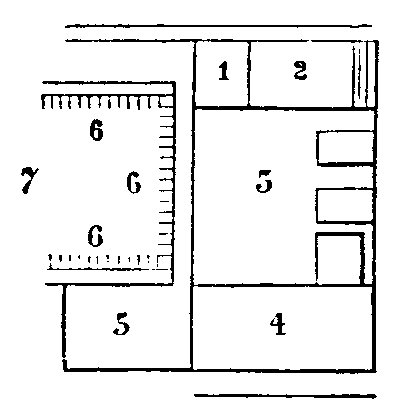
the other is our sitting and eating room; it looks out upon the Greek and other vessels, the fortifications of Valetta, some few houses of the town, two windmills, and the great church of St. John. No. 3 is a very large room 48 by 30, I suppose, and 20 to 22 high, arched. There are deep recesses through the wall for the windows, which form dressing-rooms for Hurrell and me. Our beds, at right angles to the depth of the wall, blocking them up. Our bedsteads are iron, with light musquito curtains. There we lie, with one or two thin blankets, and a very hard mattress. No. 4 is a kind of hall which we do not use. No. 5 is the kitchen. We have hired a man-of-all-work to wait on us. No. 6 is the balcony running round the inside of the quadrangle; a staircase descending from it at 7 into a court which opens by large gates upon a terrace over the water, where we have a small confined walk upon the flags. On this common ground all persons on quarantine may show themselves; they may sit on the same seat successively, but they must not touch. One soon gets accustomed to this; nobody touches nobody. I have only to add that my dressing-room window opens upon the chimney of the baking-room for letters; and the sharp, sour smell often reminds me of Frank's letters which have been baked and doctored there.
Yesterday we met at the parlatorio Sir John Stodart, Chief Justice, to whom both Froude and I had letters. He gave us a good deal of curious information about the state of the Catholic Church in Malta. It seems Malta was not taken, but capitulated to us; and one of the provisions was that the laws and the religion should be inviolate. Now, the clergy here were independent altogether of the State in such a way as hardly in any other Catholic country at present. Till 1813 nothing was done, for the Government thought the island might be ceded at the peace; but, after Bonaparte's defeat in Russia, they resolved on keeping it. A Commissioner was sent out to adjust the legal and ecclesiastical system. Sir J. Richardson went on with it—when here in 1826—and Sir John Stodart is going on with it now. He is introducing trial by jury, which at first sight is a problematical improvement. As to the clergy, they were tried in courts of their {293} own (as in Becket's time), and irresponsible to the civil power. How was this to be altered? For a Catholic to violate the rights of the Church is a mortal sin, from which, not even the Bishop—no one but the Pope—can release him. Supposing, then, the King to make it law that the clergy should be subjected to the State courts, the execution of such a measure would, of course, rest with native magistrates; let them then enforce it against a priest, and then go to their confessor. The priest cannot absolve them; he has not the power: he can do nothing without the Pope's assent. This exemplifies the admirable system of the Papacy as au instrument of power. Accordingly, representations were made to the Pope—at that time Leo XII.—and, though he was considered strict in his adherence to the privileges of the Church, the Government managed to gain a continual dispensation for the Catholic magistrates here: and that thus the clergy are virtually subject to the State courts. This system of dispensations is in force in Austria.
There is another difficulty about the Bishop, who is under the Archbishop of Palermo; for which reason, and also as claiming the suzeraineté of Malta, the King of Naples claims to appoint him. I believe this is not adjusted yet, though there is no dispute just now. The Maltese are a very industrious race—a contrast to the Ionians. The most industrious servants at Corfu are Maltese. There was a plan some time since to relieve the place of its abundant population by sending them there; but, whether from the difference of religion or other cause, it did not answer. Malta increases by a thousand souls a year. It has the largest population on the smallest territory of any place in the world—above 100,000. Sir John Stodart said he had a plan for colonising them to Negropont. I suppose it would not do.
Malta
January 23.
We are just out of quarantine. We shall be in Malta ten days. Do not
tell people, of course; but we had mysterious night visitants in the
Lazaret, which have broken my night's rest, even worse than the sea, and
have given me a cold. We can account for them to a certain point, but no
further, a characteristic of most such stories. My companions both
distinctly heard steps in room 4 about two o'clock of the night of the
17th and 18th. They are perfectly convinced on the point; we are locked
in. About the same time I dreamed {294} that a man came to me (our
servant I thought) and told me it was only an hour from rising time, and
as we were going on a boat expedition next morning, I wished to be
punctual. I was so fully impressed with the reality of it, that I lay
awake for some time on my back, not thinking it a dream, and have almost
ever since woke at that hour and fancied it morning [I certainly heard
steps about my bed]. On talking it over in the morning, we recollected
we had heard noises before.
On Sunday night last, the 20th, I was awakened by a noise in room 2 as I thought, so loud that I smiled to myself, and said: 'Clearly this is too earthly to be anything out of the way.' When it had been repeated twice at intervals, it struck me that someone might be taking away Mr. Froude's effects (who sleeps in a window of that room), and who was audibly fast asleep. So the fourth time it occurred, I hallooed out 'Who's there?' and sat up in my bed ready to spring out. A deep silence followed, and I sat waiting a considerable time, and thus I caught my cold. From that time to the time we left I heard nothing. Now I must tell you that on the night of the 17th our next-door neighbour left the Lazaret about two o'clock and walked along the external gallery; but the wall between our room and the gallery is ten feet thick. You may say the noises came from some strange transmission of sound; or you may say that the quarantine island is hardly Christian ground. Anyhow, we cannot doubt that evil spirits in some way or other are always about us; and I had comfort in the feeling that, whatever was the need, ordinary or extraordinary, I should have protection equal to it [Note 7]. {295}
TO HIS MOTHER
Malta: January 26, 1833.
The weather has been unusually severe here. My cold caught in the
Lazaret ripened the day I came out of it into the most wretched cough I
ever recollect having, as hard as the stone walls, and far more tight
than the windows. This is Saturday, and we came out on Wednesday
morning, and all that while, with the exception of one imprudence, I
have been a close prisoner, nay, in my bedroom. Yesterday morning I was
not up till twelve o'clock, an event unprecedented in my history, as far
as memory goes. Today I am much better, but not well. I have engaged an
Italian master.
I have seen St. John's Church, and most magnificent it is. It is in the same style as St. Peter's; in richness and exactness, minuteness and completeness of decoration, far exceeding anything I have ever seen. I shall go to it once or twice more to get some more accurate notion of it. It is built with a nave with side aisles leading to separate chapels or altars, e.g. the French chapel, the Italian, the Spanish. It is covered throughout with the most costly marbles and with gilding; a multitude of pictures—some very fine—some statuary, splendid tapestries, and silver lamps and candlesticks of course. In the Chapel of the Communion are the famous silver rails which were saved from the clutches of Bonaparte by being painted to look like wood; he took away the gold rails. By this and similar acts the French have made themselves hated here. The Knights of St. John (the Baptist, not the Evangelist) were not allowed to leave away their property, accordingly immense sums were available for religious works. It is said they brought from Rhodes property to the amount of 300,000l. a year.
I have hitherto seen little of the Greek and Latin churches, but what I have seen fires me 'with great admiration.' I do not perceive that my opinion has in any respect changed about them; but it is fearful to have before one's eyes the perversion of all the best, the holiest, the most exalted feelings of human nature. Everything in St. John's Church is admirable, if it did not go too far; it is a beautiful flower run to seed. I am impressed with a sad presentiment, as if the gift of truth when once lost was lost for ever. And so the Christian world is gradually becoming barren and effete, as land {296} which has been worked out and has become sand. We have lasted longer than the South, but we too are going, as it would seem.
As to the number of sects which have split off from the Church, many of them have already ended in Socinianism and heresy worse than any in Rome or Constantinople. All this does not interfere with good men being in any Church, nor is there any proof that we have more than they, though if you cut away from us those who are in no sense Churchmen, though called so, I think there are more in us, as far as appearances go. By-the-bye, what answer do Protestants make to the fact of the Greek Church invoking saints, over-honouring the Virgin, and substituting ceremonies for a 'reasonable service,' which they say are the prophetic marks of Anti-Christ? I do not see that the Romanists are more than advanced Greeks, the errors being the same, though less in degree in the latter.
I was speaking just now of the Maltese disliking the French. They are said to like the Russians, as the Greeks do; but there is so much contradictory testimony. All agree that they are a very industrious race, being an exception to the general Mediterranean character; I suppose they are Arabs or Moors in great measure. Paul was Grand Master of the Order, and I suppose the Russians narrowly missing getting the island, instead of us, their troops, which were to have co-operated with the English, being suddenly called off to act together with the French against us, they appointed wealthy men as commanders of their vessels in these parts, with orders to spend a good deal of money among the Maltese population. About five years ago they quite enriched the place. At present there is extreme poverty. We are told that, if any other people were so distressed, there would be a mob of 4,000 or 5,000 starving men every morning at the Governor's palace.
I cannot help thinking how we have been favoured in the weather. The two packets which came out the two months before successively had uninterrupted bad weather. A steamer, which set out four days before us, damaged its engine, and put into Lisbon for three weeks, arriving here as we returned from Corfu. The brig that took out Lord Nugent also suffered. This is a most curious town; the people are very kind, and we overflow with invitations; but somehow I do not like the place, though I have seen little of it. I shall {297} be glad to be quiet at Rome or Naples for a while. Rome is the city of the Apostles, and a place to rest one's foot in, whatever be the after-corruption. We shall go almost by the track of St. Paul from Malta to Rome.
January 27.
Yesterday, in my solitude, I finished my Patriarchal Sonnets. I now have
completed fifty-four sets for Rose, and am not anxious to do any more;
but, when thoughts come into my head, it is impossible to resist the
temptation of fixing them. It is Sunday morning. I think of St. Mary's
and Littlemore. We do not know how great our privileges are. All the
quiet and calm connected with our services is so beautiful in memory,
and so soothing, after the sight of that most exciting religion which is
around me—statues of the Madonna and the Saints in the streets,
&c. &c.—a more poetical but not less jading stimulus than a
pouring forth in a Baptist chapel. How awful seems (to me here) the
crime of demolition in England! All one can say of Whigs, Radicals, and
the rest is, that they know not what they do. Archdeacon Froude has just
forbidden my going to church on account of my cold. I have been to
church only once since I left England.
Many the guileless years the Patriarch spent
Blest in the wife a father's foresight chose;
Many the prayers and gracious deeds which rose,
Daily thank-offerings, from his pilgrim tent.
Yet these, though written in the heavens, are rent
From out truth's lower roll, which sternly shows
But one sad trespass at his history's close—
Father's, son's, mother's, and its punishment.
Not in their brightness, but their earthly stains
Are the true Seed vouchsafed to earthly eyes.
Sin can read sin, but dimly scans high grace;
So we move heavenward with averted face,
Scared into faith by warning of sin's pains;
And saints are lowered that, the world may rise [Note 8].
Valletta: January 23, 1833.
————————————
O specious sin and Satan's subtle snare,
That urges sore each gentlest, meekest heart
When its kind thoughts are crushed and its wounds smart,
World-sick to turn within, and image there {298}
Some idol dream to lull the throbbing care!
So felt reft Israel when he fain would part
With living friends; and called on memory's art
To raise the dead and soothe him by despair.
Nor err they not, although that image be
God's own; nor to the dead their thoughts be given,
Earth-hating sure, but yet of earth enthralled;
For who dare sit at home and wait to see
High Heaven descend, when man from self is called
Up through this thwarting outward world to Heaven? [Note 9]————————————
O purest semblance of the Eternal Son!
Who dwelt in thee, as in some blessed shrine,
To draw hearts after thee, and make them thine;
Not parent only by that light was won,
And brethren crouch'd who had in wrath begun,
But heathen pomp abased her at the sign
Of a hid God, and drank the sound divine
Till a king heard, and all thou bad'st was done.
Then was fulfill'd Nature's dim augury,
That 'Wisdom, clad in visible form, would be
So fair that all must love and bow the knee';
Lest it might seem, what time the Substance came,
Truth lack'd a sceptre, when it but laid by
Its beaming front, and bore a willing shame [Note 10].
Lazaret, Malta: January 20, 1833.
————————————
Latest born of Jesse's race,
Wonder lights thy bashful face,
While the Prophet's gifted oil
Seals thee for a path of toil.
We, thy angels, circling round thee,
Ne'er shall find thee as we found thee
When thy faith first brought us near
In thy lion-fight severe.
Go! and mid thy flocks awhile
At thy doom of greatness smile;
Bold to bear God's heaviest load,
Dimly guessing of the road—
Rocky road, and scarce ascended,
Though thy foot be angel tended.Two-fold praise thou shalt attain,
In royal court and battle plain;
Then comes heart-ache, care, distress,
Blighted home, and loneliness;
Wounds from friend and gifts from foe,
Dizzied faith, and guilt, and woe; {299}
Loftiest aims by earth defiled,
Gleams of wisdom sin-beguiled.
Sated power's tyrannic mood,
Counsels shared with men of blood,
Sad success, parental tears,
And a dreary gift of years.
Strange, that guiltless face and form
To lavish on the scarring storm!
Yet we take thee in thy blindness,
And we buffet thee in kindness:
Little chary of thy fame,
Dust unborn may bless or blame;
But we mould thee for the root
Of man's promised healing Fruit;
And we mould thee hence to rise,
As our brother, to the skies [Note 11].
Lazaret, Malta: January 18, 1833.
January 28.
I am properly taken at my word. I have been sighing for rest and quiet.
This is the sixth day since I left the 'Lazaret'; and I have hardly seen
or spoken to anyone. The Froudes dine out every day, and are out all the
morning of course. The two last days they have been on a visit to a
friend [I wished and insisted on their doing all this]. Last night I put
a blister on my chest, and, never having had one on before, you may
fancy my awkwardness in taking it off and dressing the place of it this
morning. I ought to have had four hands. Our servant was with the
Froudes, and the people of the house are so dirty, cheating, and
ignorant of English, that they make a mistake whatever is told them.
Never was such a take-in as this place: we were recommended to go
elsewhere. Well, I am set upon a solitary life, and therefore ought to
have experience what it is; nor do I repent. But even St. Paul had his
ministers. I have sent to the library and got 'Marriage' to read! Don't
smile—this juxtaposition is quite accidental. You are continually in
my thoughts, of course. I know what kindness I should have at home; and
it is no new feeling with me, only now for the first time brought out,
that I do not feel this so much as I ought. Thank God, my spirits have
not failed me once. They used, when I was solitary, but I am callous
now. Last night, as I put on my blister, I reflected it was just a week
since I caught my cold at the Lazaret by speaking to a ghost. I wonder
how long I shall last without any friend {300} about me. Scripture so
clearly seems to mark out that we should not be literally solitary. The
Apostles were sent two and two, and had their attendants, so I suppose I
should soon fail. I am glad Frank [in Persia] has the comfort of friends
about him.
February 2.
Since I wrote, Dr. Davy (to whom we had letters through Mr. Hawkins
among others) has recommended me a simple remedy, which has almost, if
not entirely, cured my cough—fifty drops of antimonial wine three
times a day. My morning dose has made me feel not qualmish but languid
till breakfast-time, but otherwise I have had no inconvenience from the
remedy at all, and it is wonderfully efficacious.
Naples
February 14.
Just arrived at Naples. I am quite well, as if I had never had a cough.
We have seen Egesta, Palermo, and Messina.
TO HIS SISTER HARRIETT
Naples: February 16, 1833.
Our two days' impression of Naples is very unfavourable. We find a
climate variable, capricious, bleak, stormy, and miserable; moreover,
the streets overrun with mud and water, not dripping, but pouring from
the houses. We find everyone we come in contact with—custom-house
officers, shopmen, and populace—thieves and cheats, having been
subjected, every step we have taken, to all sorts of provoking
impositions. We find such despicable frivolity, so connected with
religious observances, as to give the city a pagan character. I am in
vain trying to find out whether there are any letters from you to me at
the post-office. They are so careless that some persons have been kept
from their letters before now for five weeks, and yet I do not know what
other direction to give you than Naples. We shall stay here about a
fortnight. I got my Mother's letter yesterday from the Neales. My
present notion is to get Edward Neale to go through Sicily with me in
April. The Froudes have decided on giving up Sicily and going home by
the Rhine.
Well, we left Malta on the 7th. Its climate is uncertain and stormy in winter, though more than usually so this season. Some days, after we left the 'Lazaret,' were piercingly cold. Dr. Davy told me there was an endless passage of wind from Africa to Europe during the winter, and that the {301} barometer was always very unsettled. I was confined to my room nearly the whole fortnight we were out of quarantine. The Neapolitan steamer came (on Monday the 4th) just as I was getting quite well of my cough. On Tuesday I went to St. Paul's Bay by water; and this expedition, with walking a little about the streets, is all I have seen of Malta. The houses are superb. They are great palaces. The Knights spent their money in houses and fortifications. The houses in Messina, Palermo and here are very splendid, but they are inhabited in floors; whereas in Malta one man—Say Dr. Davy—has the whole house, with its square court within, galleries, &c. The rooms are magnificently lofty, and every part of stone. The streets are straight, and at right angles to each other; the fortifications prodigious in point of size and extent, but not worth much in a military point of view, each Grand Master adding to his predecessor's work without unity of plan or use for modern purposes. St. John's Church properly belonged to the Government, and might have been made the Protestant Church, as it was built by the Knights, and not part of the island's Church property; but, by mismanagement, it was given to the Romanists, or perhaps it was impossible for us to do otherwise. The present Protestant chapel is insufficient to contain more than the chief English families; the multitude of English being left to either total neglect of religious observance, or to the Roman Catholic priests, or the Wesleyans, as the case may be.
I forget what opinion I gave about the attachment of the Maltese to the English; our final and confirmed opinion was that they do not like us. England has laid a heavy corn tax on them, which galls them much; 120,000l. is thus raised, which is profusely laid out in quasi-sinecures, and, after all, a balance is transmitted to England. Few Maltese are put into any posts of importance. It is urged, on the other hand, that responsible men, Englishmen of wealth, must be put into places which yet it is confessed none but Maltese deputies can execute. So much about Malta.
We left Malta on board the 'Francisco,' a Glasgow-built steamer beautifully appointed, with passengers to the number of seventy or eighty, who had come from Naples to see the island. There was Prince Galitzin, and the wife of the Governor of Wallachia and Moldavia, and counts and princes numberless, who spat about deck and cabin without any concern, Poles, Russians, Germans, French. The only gentlemen-like {302} men were the princes of Rohan [Note 12], Carlists, who prosecuted Madame de Feucheres last year. The elder one was a sedate and pleasingly-mannered man, with a countenance like Henri IV. Our voyage was singularly prosperous—a calm sea and a warm atmosphere. We got to Messina in twenty-four hours, and landing at one in the morning, encountered the misery of custom-house officers for the first time, and a strange language (it was our first foreign ground), and unluckily as we landed it began to rain copiously. We were two days at Messina, and starting thence on Saturday evening (last) arrived at Palermo early Sunday morning. There the steamer stayed two days; on Wednesday morning we left Palermo and arrived here with a swift passage in twenty hours on Thursday. Thus I give our itinerary before speaking of Sicily.
Little as I have seen of Sicily, it has filled me with inexpressible delight and (in spite of dirt and other inconveniences) I am drawn to it as by a loadstone. The chief sight has been Egesta (Segesta), its ruins with its temple. O wonderful sight! full of the most strange pleasure—strange from the position of the town, its awful desolateness, the beauty of the scenery, rich even in winter, its historical recollections by contrast with the misery of the population, the depth of squalidness and brutality by which it is surrounded. It has been a day in my life to have seen Egesta. From the moment I saw Sicily I kept saying to myself, 'This is that Sicily'; but I must stop if I am to find room in this letter for Messina and Palermo, though really my mind goes back to the recollections of last Monday and Tuesday, as one smells again and again at a sweet flower. {303}
February 17.
Another day of pouring rain, and a miserable scirocco, howling as at
Corfu. The wretches at the post-office, to whom I have been five times,
and most of the times by their own appointment, have not yet examined
whether there are any letters due to me from you, though I cannot doubt
there are. Well, for my narrative:—When we rose on the Friday morning,
the 8th, Sicily laid alongside us in mist, Etna invisible, at least its
top. As we approached the coast, we saw a vast number of ridges running
up the country, steep, sharp, and covered with olives and vines, every
now and then a sand-course into the sea, the bed of a fiumara or
torrent. We were off Taormini: Italy on the other side in mist. We
landed by about ten o'clock, and having so many on board, had a
difficulty in getting lodged. In spite of the threatening weather, we
walked up a high hill, 2,000 feet (the next day was beautiful), and I
saw at my feet the Straits of Messina, with Scylla and Charybdis and the
fine coast of Calabria, with Reggio. Charybdis is now the site of the
Mole, and consists of little whirlpools, which in consequence have spent
themselves. But both it and Scylla are still dangerous for small sailing
vessels, which, getting into the current from the one, are sent forward
upon the other.
We went into many of the churches both here and at Palermo, and saw somewhat of the Roman service, which is less reverent than the Greek, being far more public. There is no screen, the high altar is in sight. Palermo is a far richer and finer place than Messina; some of the churches are magnificent. It is a beautiful city, and contains 160,000 inhabitants. It lies in a splendid bay of bold mountains, snow-capped in part. On the extreme right as you enter is Monte Pellegrino, which in ancient times, I think, Amilcar held for three years against the Romans. The whole scenery is wild and fearful, with a very rich valley lying at the foot of it, in which the city is placed. Far on the left you see Etna, a mass of white with a small cloud above its summit. The city mainly consists of two streets intersecting each other at right angles, and one of them perhaps a mile long. The houses are very fine; numerous convents, which run along the upper floors—shops, &c., being below. There is a splendid promenade running along the water's edge. It was the carnival time, and the main streets were thronged with people as full as London. Fancy this at the length of a mile. The beggars were incredibly {304} importunate, thrusting their hands into one's face and keeping them there for several hundred yards, till they came to the end of their beat, when others succeeded them. They have a miserable whine, in all parts of the island that we have seen, so as to make one quite nervous. The streets are filthy beyond expression, and the mixture of greatness with littleness is strange to an Englishman. They are paved side to side with flags; there is no footway. At Naples they are not so filth as in Sicily, and the beggars less troublesome, but the boys at Naples are thieves. Froude has already lost a handkerchief, and I have had one half pulled out of my pocket, and have caught one or two boys peeping into it.
We dined last Tuesday at Palermo with Mr. Ingham, one of the principal British merchants, and yesterday (at Naples) with Moberly's brother-in-law, Mr. Bennett, the chaplain here. I ought to give you an account of an Italian dinner as we first became acquainted with it on board the steamer, after waiting till we were very hungry. First a course of cheese, pickles, anchovies, raw sausages of mule's flesh—then soup, then some boiled meat, then fish, then cauliflower, then a fowl; lastly, pastry with dessert. You are never helped twice. I see now the meaning of the English phrase, 'cut and come again.' Yet sometimes, as at Mr. Ingham's, this dinner becomes quite superb. All over the South, according to our experience, after two or three glasses of wine, the cloth not being removed, coffee (one small cup) is brought in, which is followed by some liqueur, and so the entertainment ends.
TO HIS SISTER JEMIMA
Naples: February 19, 1833.
We have fallen on bad weather at Naples. The books tell us that a
perpetual spring is here; but more piercing winds, and more raw,
wretched rains, I have scarcely ever felt. For invalids the place is
emphatically bad; especially when they don't see the harm of linen wet
from the wash. But yesterday, when we went to Baiæ, was a magnificent
day. On Thursday evening we went to the Opera. In spite of my reasonings,
which I continue to think sound, I felt so great a repugnance to going,
that, had I been alone, I should not have gone. There was nothing there
to offend me, however, more than that the whole city offends me. It is a
frivolous, dissipated {305} place. This is carnival time, and all sorts
of silly saturnalia between King and people are going on. Religion is
turned into a mere occasion of worldly gaiety—as in the history of the
Israelites—and the sooner we are out of so bad a place the better. And
now I shall leave mention of Naples, which, even in its scenery much
disappoints me, after the glorious Sicily and the majestical bay of
Palermo.
That bay is, in my eyes, far finer than that of Naples. It is not to time purpose that we have had bad weather here, for I am speaking of outlines. The bay of Naples is partly surrounded by lumpish cliffs. In Palermo you have a theatre of the most graceful mountains. Here is the difference between Sicily and Greece. As far as the drawings I have seen, and my experience, such as it is, confirms them, in Greece the view is choked up with mountains; you cannot move for them. But in Sicily you have ample plains [Note 13], and the high ground rises out of them at its ease, calmly, and with elbow-room. This is the beauty of the bay of Palermo; but other influences come in to move me. I saw the most interesting (profane) country after Egypt; and its history—beginning with the highest antiquity—unites in due time both with the Greek history and the Roman. It was the theme of almost every poet and every historian, and the remains in it of the past are of an earlier antiquity and more perfect than those of other countries. And now it lies in desolation under a bad Government. Not tricked out in the vanities of modern times, but as if in mourning, yet beautiful as ever. These thoughts suggested the following sonnet:
Why, wedded to the Lord, still yearns my heart
Upon these scenes of ancient heathen fame?
Yet legend hoar, and voice of bard that came
Fixing my restless youth with its sweet art,
And shades of power, and those who bare their part
In the mad deeds that set the world in flame,
So fret my memory here—Ah! is it blame
That from my eyes the tear is fain to start? {306}
Nay, from no fount impure these drops arise;
'Tis but the sympathy with Adam's race
Which in each brother's history reads its own.
So let the cliffs and seas of this fair place
Be named man's tomb and splendid record stone.
High hope pride-stained, the course without the prize [Note 14].
Messina. February 9, 1833.
At Palermo the wife of the Governor of Moldavia and Wallachia took the whole town. After being boxed about from place to place, we contrived to secure two rooms, which we pronounced to be unbearably filthy. But it is astonishing how our standard falls in these parts. On our return from Egesta we pronounced them to be, 'after all, very fair apartments.' We got into them by ten or eleven on Sunday.
That night we went to bed early, and were called at three next morning to commence our journey to Egesta, for we were resolved to make the most of our time, the vessel starting on Wednesday morning for Naples. By four we were off. A travelling carriage, drawn by three mules with bells, a driver and his boy behind, and a servant hired as a guide for three days, formed our set-out. We stop in the town at a café for something warm in the shape of coffee, for we have a journey of forty-three miles before us over a cold mountain country; and then eight or nine miles to and fro on mules before we were to eat or drink again. A morsel of bread was our sole breakfast. The revellers were returning home from the grand masquerade as we recommenced our journey, the mule-bells ringing and clinking in the dark, till we came to the suburbs, and began our long ascent of twelve miles. What a wonderful prospect broke on us with the day—wild, grey, barren eminences tossed about, many with their heads cut off by clouds, others lighted up by the sun! Then we descended into a stupendous valley, a sheer descent of rock on each side of us, of perhaps a thousand feet, meeting at an acute angle, and the road then cut on one of them. Then followed a richly fertile plain, large every way, full of olives, corn, vines, with towns interspersed, the bay of Castel-a-mare bounding it, around which bold and beautiful mountains rear themselves. After passing through one town we came to Scala di Partenico, where we changed horses, and soon came to Alcamo, thence to Calatafimi, which ended our drive, by half-past one. I now begin to understand how Sicily was a corn country, not merely in vales and plains, but up slopes of long hills which are cultivated up to the top, and in the midst of rocks and precipitous descents. {307}
I recommended a slight 'refection,' as Lady Margaret would say, before starting on our mules; so, after an egg or two, we set off for the Temple, which is four miles off, and which came in sight suddenly, after we had advanced about a mile. Oh that I could tell you one quarter what I have to say about it! First, the surrounding scene on approaching it is a rich valley—now, don't fancy valleys and hills as in England; it is all depth and height, nothing lumpish—and even at this season the colouring is rich. We went through groves of olive and prickly pear, and by orange orchards till we came to a steep hill covered with ruins. We wound up the ascent—once doubtless a regular road to the city gate—and, on surmounting the brow, we saw what we had seen at a distance (and what we saw also afterwards at the end of a long valley on leaving the plain of Castel-a-mare for Palermo), the Temple. Here the desolation was a striking contrast to the richness of the valley we had been passing. The hill on which we stood was covered with ruins, especially of a theatre. Opposite to it, a precipitous rock started out of the ravine below. On the hill beyond it there were, as on our hill, ruins; and we conjectured they might mark the site of the Greek town, but on the circular hill there was nothing but a single Temple. Such was the genius of ancient Greek worship—grand in the midst of error, simple and unadorned in its architecture: it chose some elevated spot, and fixed there its solitary witness, where it could not be hid. I believe it is the most perfect building remaining anywhere—Doric—six gigantic pillars before and behind, twelve in length, no roof. Its history is unknown. The temples of later and classical times have vanished—the whole place is one ruin, except this in the waste of solitude. A shepherd's hut is near, and a sort of farmyard—a number of eager dogs—a few rude intrusive men, who would have robbed us, I fancy, had they dared. On the hill on which the theatre stood was a savage-looking bull, prowling amid the ruins. Mountains around and Eryx in the distance. The past and the present! Once these hills were lull of life! I began to understand what Scripture means when speaking of lofty cities vaunting in the security of their strongholds. What a great but ungodly sight was this place in its glory! and then its history; to say nothing of Virgil's fictions. Here it was that Nicias came; this was the ally of Athens; what a strange place! How did people take it into their heads to plant themselves here? At length we turned {308} about, and got back to Calatafimi by six o'clock. And now I ought to tell you about Calatafimi and the towns we passed through to get there, in order to complete the picture, but I have not done it and cannot.
I send two songs à la mode de Walter Scott.
When mirth is full and free,
Some sudden gloom shall be;
When haughty power mounts high,
The Watcher's axe is nigh.
All growth has bound; when greatest found
It hastes to die.When the rich town, that long
Has lain its huts among,
Rears its new structures vast,
And vaunts,—it shall not last!
Bright tints that shine are but a sign
Of summer past.And when thine eye surveys,
With fond adoring gaze
And yearning heart, thy friend,—
Love to its grave doth tend.
All gifts below, save Truth, but grow
Towards an end [Note 15].
Valletta: January 30, 1833.
————————————
When Heaven sends sorrow,
Warnings go first,
Lest it should burst
With stunning might
On souls too bright
To fear the morrow.Can science bear us
To the hid springs
Of human things?
Why may not dream
Or thought's day gleam
Startle, yet cheer us?Are such thoughts fetters,
While Faith disowns
Dread of earth's tones,
Recks but Heaven's call,
And on the wall
Reads but Heaven's letters? [Note 16]
Between Calatafimi and Palermo: February 12, 1833. {309}
TO HIS MOTHER
February 28, 1833.
We leave Naples for Rome tomorrow morning. You may send me letters
directed either to Naples, to Mr. Oates, 70 Vicolo Freddo, or to Rome,
till just after the Oriel election, which is April 12; a letter will get
to me by May 2 at Home or Naples on my return (please God) from Sicily
homeward. I suppose I shall get to England by the beginning of June.
We returned yesterday from Pæstum. We have not achieved Vesuvius. To return to Sicily.
I left Jemima without an account of the condition of the lower classes in Sicily. I will now give you a traveller's description, which is proverbially superficial. The mixture of grandeur and dirt in the towns is indescribable, and to an Englishman incomprehensible. There, at Naples and at Palermo and Messina, the beggars are fearful, both in their appearance and their importunity. One fellow at Messina stuck by us for two hours. At Palermo they have beats; here at Naples their horribleness has most struck me: at Palermo their dirt and squalidness. Oh, the miserable creatures we saw in Sicily! I never knew what human suffering was before. Children and youths who look as if they did not know what fresh air was, though they must have had it in plenty—well, what water was—with features sunk, contracted with perpetual dirt, as if dirt was their food. The towns of Partenico and Alcamo are masses of filth; the street is a pool; but Calatafimi, where we slept!—I dare not mention facts. Suffice it to say, we found the poor children of the house slept in holes dug into the wall, which smelt not like a dog-kennel, but like a wild beast's cage, almost overpowering us in the room upstairs. I have no sleep all night from insects of prey; but this was a slight evil. The misery is increased from the custom of having the stable on the ground floor and the kitchen on the first. The dwelling is on the second floor. Yet it is pleasing to discern a better seeming class amid the misery; even at Alcamo there were tidy clean-looking women, and outside the towns much washing was going on. A great number of the Sicilians and Calabrians we have seen are a striking and bright-looking race—regular features and very intelligent. Sparkling eyes, brownish skins, {310} and red healthy-looking cheeks. At Amalfi yesterday we were quite delighted with them.
The state of the Church is deplorable. It seems as if Satan was let out of prison to range the whole earth again. As far as our little experience goes, everything seems to confirm the notion received among ourselves of the priesthood, while on the other hand the Church is stripped of its temporalities and reduced to distress. The churches at Messina and Palmero are superb, and there is a fine church at Monreale, which is the see of the Primate (there are, perhaps, ten sees in the island). It is worth 10,000l. a year, but the present bishop compounds with Government for 2,000l. I think I heard that originally the Sicilian Church was expected to support the poor, but that the bishops compounded for this by giving a certain sum to Government, which is now spent in paying Government pensions. We have just heard of the Irish Church Reform Bill. Well done! my blind Premier, confiscate and rob, till, like Samson, you pull down the Political Structure on your own head! At Naples the poverty of the Church is deplorable. All its property we are told is lost. The grandfather of the present King, the Lazzaroni king, began the confiscation; the French completed it. Thus these countries have the evils of Protestantism without its advantages—that is, Anglican Protestantism; for there are no advantages whether in schism like Dissent, or Socinianism such as Geneva's. But here, too, they have infidelity and profaneness, as if the whole world (Western) were tending towards some dreadful crisis. I begin to hope that England after all is to be the 'Land of Saints' in this dark hour, and her Church the salt of the earth. We met in the steamer an American who was a pompous man, and yet we contracted a kind of affection for him. He was an Episcopalian, and had better principles far than one commonly meets with in England, and a docile mind. We are quite sorry to have lost sight of him. Is the American Church to serve any purpose in the Divine scheme? I begin to inquire whether the Revelations do not relate to the European world only, or Roman Empire, so that as ages of time may be summed up in the first verses of Genesis, and the history commences only with the creation of man, so the prophecy may end with the history of Christianity in the Roman Empire, and its fortunes in America or China may be summed up obscurely in a few concluding sentences; if so one would almost expect some {311} fresh prophecy to be given when the end of the European period comes. I should add we afterwards found out that our good friend belonged to the Wesleyan Episcopalians. To return, doubtless there are God's saints here, and perhaps brighter ones than with us. We heard of one man—at Messina, I think—who, while bearing his witness against the profligacy of the priesthood, rigidly attends Mass, and, on being asked why, answered that the altar is above the priest, and that God can bless His own ordinances, in spite of the instruments being base. This seems very fine, but the majority of the laity who think, run into infidelity. The priests have lost influence exceedingly since the peace. The French Revolution and Empire seem to have generated a plague, which is slowly working its way everywhere. At Malta we heard the same, and at Corfu.
I have been asking myself what the especial beauty of Naples (that is the Bay) is, and why we are disappointed with it, which we continue to be. Now its fame seems to arise, first, from the mountains and high hills scattered round it, and next from the beauty of the colouring. Now, as to the second point, we have not seen this by reason of the season. I can fully believe that in fine weather the painting of the scene is enchanting, and am convinced that the colours are almost different in kind from anything we have in England. But this I believe is the case with Corfu too, and in fact I think that Corfu had spoilt us for Naples. As to the first point, the land outline is certainly fine, especially Vesuvius, a graceful object on the left, and the islands. Add to these a grand expanse of water, calm, and dark blue—what can be finer? Nothing, to those who have not seen Corfu. The panorama there is far grander and more varied. The town itself contains two picturesque rocks. Naples is surrounded by lumpish cliffs like bolsters. Vesuvius indeed is perfect in its way as a beautiful object, but cannot compare in grandeur with the San Salvadore range at Corfu, which is a long ridge as high as Vesuvius, and is taken up by the Albanian mountains, some of which, 100 miles off, are little inferior in height to the Alps. Whereas the Salerno range, striking as it is, is at the highest point not above 4,000 feet. Then at Corfu you have inland seas, and hills covered with olive-trees far finer in shape and size than anything I have found here or in Sicily, and the beautiful cypress, which I have seen nowhere else. So that we have come to the conclusion that Naples is a watering-place {312} with watering-place scenery, and will be admired chiefly by watering-place people; with a delightful climate in its season—a place for animal gratification and as such chosen by the luxurious Romans, who, tired with the heat of Rome, made Baiæ their Brighton. We have seen the villas of Lucullus, Cicero, Cæsar, &c., which skirted its coast; there are the ruins of numberless others all along from Misenum to Pozzuoli, to Pompeii, &c. But if we want real beauty, not mere luxury, we must cross to the other side of the Salerno range, and see Salerno itself, Vietri, Cetara, Maiori, Maiori, Atrani, and Amalfi.
We have seen the Lake Avernus, the Sibyl's grotto, and Cumæ, and eaten oysters at Fusaro.
We have been to Pompeii and Herculaneum—wonderful sights!—and had a prosperous expedition to Pæstum, where the temple exceeded my expectation.
Rome
Rome: March 3.
We arrived here safe yesterday evening after a tiresome journey.
We have just heard Mr. B., the chaplain here, a perfect watering-place preacher, semi-evangelical. Mr. Bennett, at Naples, is an accomplished man; has travelled much, speaks various languages, and is liberal; he will be a great loss to the chapel there.
This is a wonderful place—the first city, mind, which I have ever much praised. We were at St. Peter's yesterday. It is of a prodigious size. Everything is so bright and clean, and the Sunday kept so decorously.
TO HIS SISTER HARRIETT
Rome: March 4, 1833.
I hope my plans are pretty well settled. Edward Neate, who is here, is
well disposed to go with me to Sicily. Impatient as I am to return on
every account, I feel it would be foolish, now that I am out, not to do
as much as ever I can. I only wish I could have the satisfaction of
hearing from you. It is now three months—thirteen weeks today—since
I left Oxford, and I have only had my Mother's letter and yours of
December 17. It would be a great satisfaction merely to know you had
received my letters. I am always making conjectures of the dates at
which you ought to get them. {313}
Pompeii and Herculaneum are wonderful places, but they do not move me. They are curious and strange. Pompeii was destroyed by ashes, Herculaneum by lava. The lava must have been quite liquid, and in immense quantities. It has literally filled up every part of the theatre, as water might; every recess, every crevice is blocked up; it has got through the windows and doors, and run about everywhere. What a torrent it must have been! It was the first eruption of Vesuvius for centuries, though Pompeii is built upon lava, and there is evidence of a crater before the date of the destruction of the two cities. But it was a crater so seemingly spent that it was covered with vegetation, and something like the crater of the Solfatara now, which is a royal park [in Vesuvius it was that Spartacus and his followers took refuge]. Again, while Etna's eruptions are continually mentioned in history, there is a silence about those of Vesuvius. After its breaking out (A.D. 70-80) it continued in action till about A.D. 1100, when it ceased for nearly five centuries, and then the vegetation gradually returned. We have an account from writers who ventured down its crater; they went down a mile or two. The mountain is altogether the creation of volcanic action. Lava was thrown up from the level of the surface, hardened, and formed a cone; fresh lava was thrown up in time, and thus the mount gradually rose and increased. Even now its height is continually varying. The eruption of 1822 lowered it by breaking away the sides of the crater; then afterwards there was more lava, and it recovered its height.
To return: Pompeii, of course, is full of interest; the amphitheatre most of all. The people were at the games when the cinder clouds fell. You have the lions' den distinct; a lion's bones were found there, and the bones of the keeper. Excavations are going on in both cities, but very slowly. The royal palace of Portici is built over Herculaneum; not much will be done there. It is five miles from Naples; Pompeii, on the same road, fifteen.
We set off for Pæstum this day week (February 25), passing Pompeii to Nocera and La Cava, and so to Salerno. I have not seen such scenery since I was in Sicily. Salerno is a beautiful town, and the inn is very respectable. It set in to rain just after we arrived, so from 2 P.M. the day was lost. Next morning at five we set off for Pæstum. The country is highly cultivated, and the country people are well dressed. {314} They are strong, handsome, and pleasant-looking. They gave us a very favourable notion of the peasantry. I think the murder of Mr. and Mrs. Hunt some years back at Pæstum was hardly more [in intention] than what a petty theft would have been in England. The murderers were not bandits. Mr. and Mrs. Hunt took a good deal of plate with them, and showed it. Some labourers in a field near the road, without previous design, were seized with the temptation to plunder them; and Mr. Hunt stooping down as if to seize hold of a pistol, one of them at once fired. The shot went through him and his wife. The assassins made off. [The peasantry take their guns with them into the fields. This afterwards I saw on the eastern coast in 1847-8. Why is it allowed?]
The roads are very well guarded now, and excellently made. There were five parties there, besides ourselves, the morning we went there.
There are ruins of two [Greek?] temples, a basilica, a theatre, amphitheatre, Roman temple of peace, city walls, gates, the foundations of the greater part of the city, &c. The country is not striking, though the Apennines are fine; but the large temple far exceeded my expectation; it is as far superior to the temple at Egesta as its situation and the scenery round are inferior. It is, indeed, magnificent. We got back to Salerno comfortably by six in the evening, and next morning went to Amalfi, and back by sea. This side of the Bay of Salerno contained such cliffs, ravines, caves, towns perched aloft, &c., that I am full of silent, not talkative, delight. How can people talk of the beauty of Naples with such true beauty in the neighbourhood? Amalfi is a town in one of these ravines. The mountains open, and a long, narrow, steep valley winds through their folds; two abundant streams run down it. On these streams there are fourteen paper mills, which pond up and then pour down the water from a number of precipitous heights. As you ascend, you are surrounded by cascades, and grots with green creepers. All is beautifully cool and sweet. The rocks above are 1,000 or 1,500 feet high. We were particularly pleased with the look of the population. All were so neat and clean. There was not a bad smell in the whole place, and they were handsome. We met, coming down the hill, a clerical school (such as we had often seen elsewhere); the boys were so bright and smiling and intelligent-looking. There were a great many of them—boys from fourteen to seventeen years {315} old. We had hoped to get over the mountain to Castel-a-mare, but did not venture. We rowed back, and so to Naples, where we all arrived about half-past 8, very tired, not having eaten since 7 A.M. On Thursday we packed up. On Friday set out for Rome. I have no sort of affectionate feeling towards Naples.
We are settled here in very comfortable apartments—Six rooms, kitchen, servants' room, and house-tops—for thirty scudi the month, i.e. about 1l. 11s. the week. They are clean and airy [in the Via Babuino], a few doors from the Wilberforces and E. Neate. And now what can I say of Rome, but that it is the finest of cities, and that all I ever saw are but as dust (even dear Oxford inclusive) compared with its majesty and glory? Is it possible that so serene and lofty a place is the cage of unclean creatures? I will not believe it till I have evidence of it. In St. Peter's yesterday, in St. John Lateran today, I have felt quite abased, chiefly by their enormous size, added to the extreme accuracy and grace of their proportions, which make one feel little and contemptible. Fancy, I have been at the Coliseum, have stood in the Forum, have mounted the Capitol, have crossed the Tiber, and live in the Campus Martius, and yet I have scarcely begun to see the city. The approach to Rome from Naples is very striking. It is through ancient towns, full of ruin, along time Via Appia; then you come to the Pontine Marshes; then, about fourteen miles from Rome, to a wild, woody, rocky region; then through the Campagna—a desolate flat, the home of malaria. It is a fit approach to a city which has been the scene of Divine judgments. After a time isolated ruins come to view, of monuments, arches, aqueducts. The flat waste goes on; you think it will never have done; miles on miles the ruins continue. At length the walls of Rome appear; you pass through them; you find the city shrunk up into a third of the space enclosed. In the twilight you pass buildings about which you cannot guess wrongly. This must be the Coliseum; there is the Arch of Constantine. You are landed at your inn; night falls, and you know nothing more till next morning.
March 9.
Still no letters from you via Naples; so I have learned to
despair. I only want to know one thing—that you are all well, and that
I am not wanted. I go on acting and planning with the notion that any
moment I may be summoned back {316} [by the Bishop], though to return
without summons seems absurd; so I must be content.
Rome grows more wonderful every day. The first thought one has of the place is awful—that you see the great enemy of God—the Fourth Monarchy, the Beast dreadful and terrible. We need no Tower of Babel; the immense extent of the ruins; the purposes to which, when in their glory, they were dedicated; the arena where Ignatius suffered; the Jewish candlestick on the Arch of Titus; the columns, with the proud heathen inscriptions still visible, brand the place as the vile tool of God's wrath and Satan's malice.
Next, when you enter the museums, galleries, and libraries, a fresh world is opened to you—that of imagination and taste. You find there collected the various creations of Greek genius. The rooms are interminable; and the marbles and mosaics astonishing for their costliness. The Apollo is quite unlike his casts. I never was moved by them at all, but at the first sight of the real statue I was subdued at once. I was not prepared for this at all. I had only been anxious to see it, and the celebrated pictures of Raffaelle. They are beyond praise: such expression! What struck me most was the strange simplicity of look which he has the gift to bestow on the faces.
As to the third view of Rome, here pain and pleasure go together, as is obvious. It is strange to be standing in the city of the Apostles, and among the tombs of the martyrs and saints. We have visited St. Gregory's (the Great) Church. It is built on the site of his house; and an inscription at the entrance records the names of some of our early Bishops, including the monk Augustine, as proceeding from the convent attached to it. The Roman clergy are said to be a decorous, orderly body, and certainly most things are very different from Naples. There are no trumpery ornaments or absurd inscriptions in the streets, profaning the most sacred subjects, and the look of the priests is superior. But there are (seemingly) timidity, indolence, and that secular spirit which creeps on established religion everywhere. It is said they got Mr. Spencer quickly out of Rome because his fasttings shamed hem [This is nonsense.—J. H. N.], and that no one thinks of fasting here—a curious contrast with the Greeks. The schools are neat and pleasant-looking. One I saw yesterday, of orphan girls, was very interesting: but the choristers at St. Peter's are as irreverent as at St. Paul's. {317}
I conclude with some verses, the idea of which beset me as I walked along the Appian Way over the Pontine Marshes, while the horses were changing.
Far sadder musing on the traveller falls
At sight of thee, O Rome!
Than when he views the rough sea-beaten walls
Of Greece, thought's early home;
For thou wast of the hateful four whose doom
Burdens the Prophet's scroll;
But Greece was clean till in her history's gloom
Her name and sword a Macedonian stole.And next a mingled throng besets the breast
Of bitter thoughts and sweet;
How shall I name thee, Light of the wide West,
Or heinous error-seat?
O Mother, erst close tracing Jesus feet,
Do not thy titles glow
In those stern judgment-fires which shall complete
Earths strife with Heaven, and ope the eternal woe?
REV. J. H. NEWMAN TO FREDERIC ROGERS, ESQ.
Rome: March 5, 1833.
I hope my friends have not measured my attachment to them by the
punctuality of my correspondence, or I shall get into disgrace with many
of them, and with you in the number. Indeed, my conscience has sometimes
reproached me for my silence in your case, since you are the only person
I have heard from in England since I left (except a chance letter of my
Mother's, written a day or two after I went). You cannot imagine how
wearisome it is to be without news of home. At the time I got your
letter at Malta I was confined to my room with a bad cold, and, short as
it was, it was most welcome. Thank you for all the trouble you and your
Father and Mother took about the introductions. You know, now, I missed
some of them in England; but I availed myself of those you sent, though,
unluckily, Sir H. Hotham was away. For other reasons, besides your
letter, perhaps, you have claims upon my handwriting. I must seem
strangely inconsistent to you in having determined not to return by the
election at Easter; though, if I recollect right, I hinted to you in the
letter which first announced my plan that I might stop abroad a month or
two later. But the state of the case was briefly this: Froude and I
calculated, and found that one of us merely returning would have no
{318} effect whatever on the votes of the election, and as his Father
had determined he should stay till June (and I think wisely), it was
literally no manner of use my going back as far as my vote went; and I
fully believe you have too many well-wishers among us to need me for
anything else. And I found, too, that we were not to be at Rome till
March; so that, had I returned, I should have seen nothing, hardly, and
scarcely done more than wander about the wide sea. Still, I am extremely
anxious, and at times annoyed almost with myself, lest I have been
wrong. Were you not to succeed, I know I should reproach myself—yet I
cannot doubt you will. I am so sorry about your eyes, and hope you have
taken my advice not to say much publicly on the subject. This will get
to you just as the election is coming on—all good fortune be with you.
If you could send me just a line when it is over (and about Wood and
Wilson too) addressed to me, 'Mrs. Oates, 70 Vicolo Freddo, Naples,' it
will get to me on my return from Sicily, whither I suppose I shall go
with Neate just after the Holy Week (but do not mention this idea of
mine, for it is not settled). I long to be back, yet wish to make the
most of being out of England, for I never wish to leave it again.
Pleasures I have had in abundance, and most rapturous; yet somehow (as
was natural) aliquid desideravere oculi mei. It might have been
different were I younger; but when one's mode of life is formed, one is
often more pained than interested by what is novel.
We arrived at this wonderful place only Saturday last (March 2) from Naples. It is the first city which I have been able to admire, and it has swallowed up, like Aaron's rod, all the admiration which, in the case of others, is often distributed among Naples, Valletta, and other places. It is scarcely with patience I hear people talking of Naples in comparison—nor will I degrade Rome by dwelling on the notion. Of course, I have seen very little of it; but the effect of every part is so vast and overpowering—there is such an air of greatness and repose cast over the whole, and, independent of what one knows from history, there are such traces of long sorrow and humiliation, suffering, punishment and decay, that one has a mixture of feelings, partly such as those with which one would approach a corpse, and partly those which would be excited by the sight of the spirit which had left it. It brings to my mind Jeremiah's words in the Lamentations, when Jerusalem, or (sometimes) the prophet, speaks as the smitten of God. {319} Oxford, of course, must ever be a sacred city to an Oxonian, and is to me. It would be a strange want of right pride to think of disloyalty to it, even if our creed were not purer than the Roman; yet the lines of Virgil keenly and affectionately describe what I feel about this wonderful city. Repeat them in your memory every word, and dwell on each. 'Urbem, quam dicunt Romam, Melibæe, putavi, stultus ego!' &c. And if you had seen the cypresses of Corfu, and the graceful, modest way in which they shoot straight up with a composed shape, yet boldly in their way, being landmarks almost for miles round, you would see the beauty of the comparison of the inter viburna cupressi. Since I have been abroad I have been taking in stores of pleasure for many years to come. It is impossible to enter into the full power of what one sees at once—the sights of celebrated places are like seeds sown in the mind. I have often felt the retrospect more delightful than the first enjoyment, great as that was. It is strange, too, the different kind of pleasure one has in different places. Only think, I have seen Ithaca—seen it for hours—coasting, in fact, all round it; and then again Rhium and Antirrhium and Corcyra—and again Sicily—and the landmarks leading to Carthage. All these places had their own pleasure, and as different as Homer is from Thucydides. I have so often wished for you and others to share my gratification, but the plague is, one feels it never can be. In other cases one says, 'Well, some other day, perhaps'; but, though you may see, I shall not—it is a thing past with me, not to return.
For two months we were without sight of English news. At Naples, even, it is difficult to get an English newspaper, but here there is a reading-room, where papers are regularly received. It has surprised us to see how far Ministers have gone in their Irish Church Reform Bill—abolishing sees, taxing benefices immediately, &c.; not that we doubted their sacrilegious will, but thought them now too much of Conservatives. If it is any consolation to have partners in misfortune, we have abundance here; for the clergy all through Italy and Sicily (as far as we have been) appear to be in a wretched state of destitution (i.e. more or less). In Sicily a great portion of their revenues is appropriated for the payment of Government pensions—in Naples, &c., their property seems to have been almost entirely confiscated, the French having completed and confirmed the spoliation. They subsist by their Masses in the most cowardly contemptible way {320} possible, not having had spirit enough to resist, but keeping good friends with their robbers. They seem to have lost all hold on the people, and we learn (as at Malta and elsewhere) that there had been a considerable growth of avowed infidelity in the course of the last fifteen years. It strikes me the superb religious edifices with which Italy abounds are a great snare to the clergy—they are a property of theirs which the State holds as a bond for their servility. 'We will take your rich churches' is a virtual threat which persuades them to submit to any insult or injury. At least, I think most men would be exposed to the temptation had they such wonderful structures. I am alluding now to the churches of Rome chiefly—we have seen only a few, but the principal—and no words can describe them. They could not have been in any place but Rome, which has turned the materials and the buildings of the Empire to the purposes of religion. Some of them are literally ancient buildings—as the Pantheon, and the portion of the Baths of Diocletian which is turned into a church. And all—St. Peter's, St. John Lateran, &c.—are enriched with marbles, &c., which old Roman power alone could have collected. The first effect produced on the mind by these noble piles (and I can as yet speak of no other) arises from their gigantic dimensions—everything is proportioned to the size of the building. The statues of the Apostles (e.g.)—all that the Germans would call insanæ molis—produce quite a moral effect of humiliation on the homunciones who gaze on them. Thus we have all the richness of the latter ages of the arts added to the magnitude which is the peculiarity of the early Egyptian, Cyclopean, &c. It is a realisation of the skill and power of Dædalus, who was beautiful while he was stupendous (posuitque immania templa, &c.). Talking of great works, I have seen Pæstum, and the principal temple there far exceeded my expectations. It is, indeed, wonderful; but you know it so well from pictures that nothing can be said about it except that it is wonderful. The most exquisite treat we have had was a visit to Egesta, to see the ruins and the remaining temple. The contrast between the wildness and the richness of the country we went over with the utter desolation and loneliness of the spot itself and the miserable state of the population, and our own little sufferings in the way of indescribable filth and annoyance, combined to stamp quite a picture on the memory, which is every day more touching. The temple itself is very fine, but {321} the situation—oh, the situation! What strange fellows those old Trojans and Phœnicians were to place themselves in so wild a place! When the city was in its splendour in Roman times it must have been very magnificent. It is perched on the top of a high hill (higher far, I should think, than the [akropoleis] of Greece), and a long stair wound up to the city gate.
You have an unintelligible paragraph in your letter in which you seem to quote some words from my last. I quite forget what they were about, but suspect about verse-making. If so, I really think you should give it a trial, as you seem disposed to do. If e.g. you feel disposed to mathematise (as men do on the top of coaches) well and good. This may be a better employment; but, rather than none, attempt verses. One ought to make the most of one's talents, and may write useful lines (useful to others) without being a poet. Ten thousand obvious ideas become impressive when put into a metrical shape; and many of them we should not dare to utter except metrically, for thus the responsibility (as it were) is shoved off of oneself, and one speaks [hos paidizon], though serious. I am so convinced of the use of it, particularly in times of excitement, that I have begun to practise myself, which I never did before; and since I have been abroad, have thrown off about sixty short copies, which may serve a certain purpose we have in view. Should you want a subject for conversation the next time you happen to see my Mother (if by yourself; for pray be mum about this to every one), you may ask for such as I have sent home, or, at least, for the more lively ones, for many are sonnets, which are proverbially dull. At least the sight of them may stimulate you, and put you in good spirits, and suggest ideas and how to begin—which is the great difficulty in all things.
Pray remember me most kindly to all friends, though
I hope to write to many of them in a day or two. Please to write my name
in my Tillemont, for which you have observed, doubtless, I have as yet
no fitting place in my library; but I hope it is duly spread, as I
ordered it to be, on the escritoire between the windows, that it may cut
a figure. By-the-bye, I left one or two drawers of the said piece of
furniture open for you (have you found them out?) with some regret that
I had closed so many. I often think of you, and fancy you in my rooms.
Oxford is the first of cities. What does Telemachus say of Ithaca? I
read great part of the 'Odyssey' (beginning {322} directly old Atlas was
visible) while we wandered up and down the Mediterranean; and have read
more of Virgil, and sapped at it, than I have done since I was ten years
old.
Ever yours affectionately,
J. H. NEWMAN.
REV. J. H. NEWMAN TO J. F. CHRISTIE, ESQ.
Rome: March 7, 1833.
… Now I am in for it the
chance is I shall stop as long as I can, and see all that can be grasped
in the time, for I sincerely hope never to go abroad again. I never
loved home so well as now I am away from it—and the exquisite sights
which foreign countries supply both to the imagination and the moral
taste are most pleasurable in memory, but scarcely satisfactory
as a present enjoyment. There is far too much of tumult in seeing the
places one has read so much about all one's life, to make it desirable
for it to continue. I did not know before, the mind could be excited in
so many various ways; but it is as much so as if it were literally
pulled about, and had now a leg twitched and now one's head turned. The
pleasure which the sight of the Morea gave me was different in kind from
that which I gained from seeing Ithaca, or Sicily, or the Straits of
Messina, or again Rome. This is a fine sentence; for it seems as if I
had travelled over the Morea, whereas we only landed on the coast for an
hour or two at night at a miserable, whole-burnt, half re-built town.
Yet our visit was sufficiently picturesque. In the first place, the town
was Patras, i.e. Patræ, of which Oxford men hear in Thucydides;
and we saw in the dusk of the evening the wild mountains of both coasts,
and in the distance, Rhium and Antirrhium. Next, the country was in a
state of the wildest anarchy, swarming by land and sea with bandits and
pirates. The former extended through the whole Morea, which was at that
moment in a state of great excitement, King Otho being almost daily
expected. Accordingly some were hastening to Napoli to make interest
with him on his arrival; others, secretly favoured by Russia, were
keeping aloof, determining to watch the course of things before they
committed themselves. A worthy of the latter class presided over the
destinies of Patras at that moment, nomine Tzavellas, or Svellas,
or Sbellas, or the like. He had taken possession of the citadel, and
some time before, the French had summoned {323} him in vain. Three ships
with the colours of the three great Powers lay before the town. The
English sloop was commanded by Sir J. Franklin, who for nine or (as some
said) eighteen months had been stationed there without anyone on board
having set foot upon land! that is, from fear of being obliged to take
part with one or other of the hostile parties. We did not like to lose
the opportunity of touching the Continent, and pushed off from the
steamer in the boat. The town, so to call it, is in a miserable
condition, and we had great difficulty in the dark in keeping our legs
amid the foundations and ruins of the houses; there had been rain, and
was much mud, and it was very dark. You will say this was a curious way
of seeing a town, especially as the town was not yet built; but we
walked through the high street, which was in a tolerably forward state;
we went into various shops, we took coffee in the first coffee-house of
the place, which was full of Greek merchants, in their very picturesque
dresses, which were quite clean, since it was a feast. The coffee was
capital (we have got very little good since we have been out of
England), it is milled up in a strange way. Our most respectable
adventure was falling in with Zavellas' men-at-arms, who were not a
little surprised at seeing us, and through whom we walked with as much
silence and quiet rapidity as you would expect. On our return there from
Corfu, we found there had been a mutiny in the garrison owing to
Zavellas' refusing to pay his troops the money he had levied for that
purpose from the merchants of the place. The Russian consul had
interfered and persuaded him, and they were all engaged in putting the
castle in a state of defence against their neighbours, who were expected
to march against it. It seems quite a hopeless task to civilise the
Morea—otherwise i.e. than by exterminating vast numbers of the
inhabitants. We were told by travellers who had lately travelled through
it that there is certainly a better sort of persons, and that the
present anarchy is rather owing to the ascendency of the worst spirits
than to the character of the people. But even allowing this, how can you
alter the inveterate habit which the better class have got of succumbing
to the most violent? Nothing but great craft or great tyranny will be
able to manage them. It is curious that with all their brutality these
fellows observe most strictly the fasts of the Church, which may be
called the distinguishing feature of the Greek Communion, as Masses,
&c., is of the Latin, {324} and they both answer the same purpose,
and are a substitute apparently for moral obedience and an opiate to the
conscience. (The Greeks have two fasts of forty days in the course of
the year, besides many others of days and seasons; during these times it
seems to be scarcely possible, certainly not the custom, to get
dispensations.) Meat of any kind is literally refrained from—nay, I
believe eggs and milk; not that they are likely to consider their
bandit-kind of life as requiring some make-up. But it is the cruelties
accompanying it which must (more or less) revolt all but the most
hardened mind. I believe robbery is not more thought of in these
countries, even at most, than pilfering is with us. A bravo
adopts a profession indeed, and one in which murder may be
added to plundering; but he is not in any sense more habitually
disobedient to his conscience, or more pained or sensitive than a
dishonest servant in England who picks up stray halfpence of his master's
or purloins his tea and sugar. And sometimes the crimes which have been
most talked about and were most shocking were the chance result of
temptation. Thus in the case of the dreadful murder of Mr. and Mrs.
Hunt, which took place at Pæstum some years since … In the same way
Lord Harrowby was attacked near Naples a year or two since. It was a
rising of the country people—such an event very rarely happens—I was
told nothing of the kind had happened between these two events. They had
got a notion of Lord H. being a great English lord. It is said the
English are less likely to be attacked than men of other nations; they
make such a noise about it. Consuls and ambassadors remonstrate, and
themselves and their friends offer large rewards, so that the guilty
parties have no chance of escaping. The road from Salerno to Pæstum is
well guarded, but it is with reluctance that one believes it necessary.
The people are a fine-looking race, very well clad, and the ground is
well cultivated. I wonder whether they make a distinction between
heretics and Catholics? I suppose not ...
As to Rome, it is the most wonderful place in the world. We do not need Babylon to give us a specimen of the old exertions of our great enemy against Heaven (who now takes a more crafty way); it was an establishment of impiety. The Coliseum is quite a Tower of Babel; this is but one of a vast number of buildings which astonish one. Then when you go into the museums, &c., you get into a second world … The collection of statuary is endless and quite enchanting. The {325} Apollo is indescribable; its casts give one no notion of it; as an influence it is overpowering. And the great pictures of Raffaelle, though requiring a scientific taste to criticise, come home in a natural way even to the uninitiated. I never could fancy anything so unearthly as the expression of the faces. Their strange simplicity of expression and almost boyishness is their great charm.
Well then, again, after this, you have to view Rome as a place of religion; and here what mingled feelings come upon one—you are in the place of martyrdom and burial of apostles and saints; you have about you the buildings and the sights they saw, and you are in the city to which England owes the blessing of the Gospel. But then, on the other hand, the superstitions, or rather, what is far worse, the solemn reception of them as an essential part of Christianity. But then, again, the extreme beauty and costliness of the churches and then, on the contrary, the knowledge that the most famous was built (in part) by the sale of indulgences. Really this is a cruel place. There is more to be seen and thought of daily. It is a mine of all sorts of excellences.
The 'Lyra' goes on flourishingly. It will commence
(I hope) in May; but of course be silent. With best remembrances to the
Common-Room.—Ever yours affectionately,
JOHN H. NEWMAN.
March 9.—P.S. On reading this over I am shocked at the slipslop it contains. Pray do not incautiously let anyone see it.
TO REV. THOMAS MOZLEY
Rome: March 9, 1833.
At first sight it would seem as if there were a great contrast between
Morton Pinckney and Rome, our respective residences at present, but
really there is not a great deal. I have learned thus much by travelling,
to think all places about the same, which I had no notion of before. I
never could believe that horses, dogs, men and houses were the same in
other countries as at home, not that I exactly doubted it, but my
imagination could not embrace the notion. But now I find that even the
seasons are the same, which perhaps you are not aware of. I assure you
cold in all its varieties is felt here as well as in England. We have
had rawness and bleakness and sharpness and wet, and the wind {326} has
blown tempests. At Malta I had a cough such as I never had in my life
before, and at Naples it rained incessantly and gave me a very
uncomfortable cold. Really, I now come to think that the ancients went
on as we do, which is a further step of philosophy. I have seen
Herculaneum and Pompeii, and the museum at Naples thence enriched, and
find that the ancients used portable stoves and ate cake; and at Rome
there is a mule's head in marble, and a group of fighting dogs as like
present nature as one clog is like another.
All this is gain, and I suppose is part of that nil admirari which one gets by travelling. It is astonishing how little it seems to have been at places when one has been at them. One walks about at Corfu or Rome, and having the same thoughts, feelings, and bodily sensations as at home, cannot believe for a time that it is foreign land. And then everyone about one is at home—if they would but seem strangers to the place, they might kindle a sympathy in us; but they take it very easy, and think it no great thing to be where they are. Nay if you fall in with those who have themselves travelled more to the east and south than you, the case is worse still. You feel actually little for having been as far and no further than you have, which is a pretty kind of reward for coming all the way to see them.
Actum, inquit, nihil est nisi Pœno milite portas
Frangimus et media vexillum pono Suburra [Note 17].
I do not know how this will operate upon me eventually; and when I am back again, but really it has a strange effect now. It has in a measure destroyed the romance which I threw around everything I had not myself witnessed. Yet perhaps it has taken away no pleasure, and may be profitable. I now do not wish to see Epaminondas or Cocles; I believe them to be ordinary mortals, fruges consumere nati. Now that I am at my confessions, it may be as well to add that I have (alas!) experienced none of that largeness and expansion of mind which one of my friends privately told me I should get from travelling. I cannot boast of any greater gifts of philosophic coolness than before, and on reading the papers of the beginning and middle of February I hate the Whigs (of course, as Rowena says, in a Christian way) more bitterly than ever. We do so wish to know what the Church in general, then Oxford, and then certain of our friends in particular, think of {327} the atrocious Irish sacrilege Bill. What Magister Præpositus, e.g., says about it, and what poor Whately (entre nous).
We hope to be here a month or five weeks, and are busily employed every morning in seeing sights; for as Rome was not built, assuredly it is not to be seen, in a day. I understand the meaning of this proverb now. This is a wonderful place; you have in it remains sufficient to acquaint you with the nature of Roman magnificence and Grecian genius, which is all posterity can hope for; and in its Christian monuments it affords a third and most abundant subject for contemplation. Neate is here, and very busy in learning all that is to be learned; he is soon going to Dresden and Vienna to study German, and then he returns to England to keep terms at the Temple. The Andersons are here also, and the W. Wilberforces, so we have quite society enough, not much being wanted, when we have objects in the place itself to attend to. When I set out I expressed a wish that we should see, one or two places thoroughly, and a great many hastily, just to say we had seen them, and this wish has hitherto been fully accomplished. The only thing I regret is having been so long at Malta (four weeks), but it could not be helped ... The only thing I did then worth mentioning was to get on with conversational Italian, and this I certainly did very considerably. I had learned the grammar and structure of the language some years ago, and could read it pretty well, so I got a master and made him do nothing but talk with me. But since I have left Malta I have gone back, for I have scarcely had any need to talk since (except using a few words), for one meets with English people, at least English talkers, everywhere. My only difficulty is when I attempt to talk French, for I am sure to mix a considerable infusion of my newly acquired Italian with it, and, considering how little I speak French at all, it is obvious how very little the balance is after the deduction. Italian is a very easy language. Were I to be here a few months, and threw myself into native society, I should easily master it, and it is provoking to be near an acquisition without acquiring it, yet qu. the use, did I acquire it? Maltese itself is entirely or almost entirely Arabic; the mixture of Italian is for the most part confined to the city. It is curious to trace the consequent connexion between it and Hebrew. I have seen tables of their correspondence, and nearly all the common words in both languages (i.e. the necessaries of life, &c.) are the same. The number of {328} such agreements is very great. How remarkable it is that the Eastern nations should have so long remained the same, as in other things so in language.
Our plans for the future are quite unsettled … I shall think of you all very anxiously as I go towards Sicily. You will be in the heat of the examination for Fellows: being at a distance, I may say without breach of decorum, that I am earnestly desirous that Rogers should succeed; were I on the spot, to say this would be inconsistent with the impartiality of a judge. But I cannot doubt he will succeed, though it will be very annoying to be kept in suspense so long. Yet I am being inured to this—here I am above three months' time from England, and I have not yet heard from anyone there, i.e. except a few lines from Rogers and home a week or two after I set out. That wretched Naples keeps all the letters you direct to it! you might as well direct to its bay as to its poste restante.
Naples is a disappointing place; it has nothing to recommend it but its ices, which are capital, though here Palermo equals it—and, besides, fabricates a kind of cake called Spanish bread, which you get nowhere else; it is superb and inimitable. You in England can have no idea of it; it is eating ambrosia. If the maker imported himself to England he might make his fortune in no time. Palermo, by-the-bye, is a far finer city than Naples, and beats it in its own line, and the bay as far excels that of Naples quantum viburna cupressi. They are very extortionate at Naples. The wind ever blows, rain is always falling, the streets are most dangerously greasy (in spite of the rain)—you are sure to be run over—boys are ever picking your pocket, and the hills about the place are ugly and flat-topped. Vesuvius is graceful, and some distant heights have something of an outline; but all this is nothing to Corfu.
By this time you are quite at home at Morton Pinckney. I wish I had any means of hearing how your Baptist chapel or other stumbling-blocks are going on; there are no Baptist chapels here.
Pray give my best remembrances to the Provost and all the Common-Room. {329}
REV. J. H. NEWMAN TO R. F. WILSON, ESQ.
Rome: March 18, 1833.
I have often thought since I left England that some of our friends must
have addressed our steam-vessel with the Sic te Diva potens,
&c., so exceedingly prosperous was our voyage from beginning to end.
I do not mean to say we were exempted from sea-sickness, which indeed is
not mentioned in that invocation; nay, we had one or two tosses in the
course of our expedition, but with these necessary exceptions our
weather was perfect ...
Froude heard from Keble the day before yesterday, and so received news of Arnold's plan of Church Reform, which seems very comprehensive. If I understand it right, all sects (the Church inclusive) are to hold their meetings in the parish churches, though not at the same hour, of course. He excludes Quakers and Roman Catholics, yet even with this exclusion, surely there will be too many sects in some places for one day. This strikes me as a radical defect in his plan. If I might propose an amendment, I should say pass an Act to oblige some persuasions to change the Sunday. If you have two Sundays in the week, you could accommodate any probable number of sects, and in this way you would get over Whately's objection against the Evangelical party and others; make them keep Sunday on Saturday. This would not interfere with the Jews (who would of course worship in the parish church), for they are too few to take up a whole day. Luckily the Mahommedan holiday is already on a Friday, so there will be no difficulty in that quarter.
Rome is one of the most delightful residences imaginable. The air is too soft perhaps to suit me for a permanence, otherwise, I cannot conceive a more desirable refuge, did evil days drive one from England. But this is impossible of course, because one's duties bind one there, even were we cast out as evil; and besides, I cannot quite divest myself of the notion that Rome Christian is somehow under a special shade, as Rome Pagan certainly was, though I have seen nothing here to confirm it. Not that one can tolerate for an instant the wretched perversion of the truth which is sanctioned here; but I do not see my way enough to say that there is anything peculiar to the condition of Rome; and the clergy, though sleepy, are said to be a decorous set of men. They look so, {330} except the canons at service, who laugh and talk. Far otherwise at Naples, which is a wretched place.
TO HIS SISTER JEMIMA
Rome: March 20, 1833.
At length Froude has heard from Williams, and I have the comfort of
knowing by implication that you are all well [Note
18]. I have the satisfaction of stating that my first 100l.
has barely gone even now. When we first came here we found bright
weather, with cold mornings and evenings—that is, sun, and wind, and
snow on the mountains; since, we have had rain. Rome is said to be a
relaxing place. I think no place (to speak boldly) is good in winter for
invalids without their own care. My friends have too great a notion that
coming abroad is an opus operatum. There is an absence of frost
and fog, but nothing is more common than sudden changes of temperature,
and these are the chief occasion of catching cold. I wish I could say
Froude's cough is gone.
The two special novelties which I find in Rome are the Fountains and the Mosaics. I had no notion of either before I came here—no notion at all of the mosaics, which are an exact imitation of painting, from the Transfiguration to a Lilliput St. Peter's upon a brooch. It is the mosaics which are the chief boast of St. Peter's: first, the huge pictures I have spoken of; next, the altars, which are adorned with the most delicate and softest scrolls and wreathes imaginable. As to the fountains, those which adorn the Piazza of St. Peter's are, I suppose, twenty feet high, and take the form of a graceful white lady, arrayed in the finest, most silvery of dresses. There are a number of others—an abundance of water, in an abundance of fountains. Water is found in almost every other street.
Have I noticed the astonishing abundance of Marbles in Rome? Churches are more numerous than the fountains; and a splendour and costliness of stones which would make {331} the city a wonder if it had only one church such. It is Herod's Temple repeated a hundred times over. I have sometimes been quite aghast when, thinking I had got through the churches here or there, I have gone into one I accidentally met with, and found a fresh world of wonders. I might enlarge, too, on the- sculptures of the churches. They are splendid; but, if one must criticise, attitudinise too much for correct taste. As to the houses, I have seen little of them but, fine as they are outside, the rooms are not near so fine as those at Naples, and still less than those at Malta.
We saw the Pope at St. Peter's last Friday.
We are in good spirits about the prospects of the Church. We find Keble is at length roused, and (if once up) he will prove a second St. Ambrose; and others too are moving. So that wicked spoliation Bill is already doing service; no thanks to it. We have encouraging accounts about Prussia from M. Bunsen, who has received us very kindly. There is every reason for expecting that the Prussian Communion will be applying to us for ordination in no long time. We hear, also, much about Germany, in the way of painters! which leads us to hope that a high reverential spirit is stirring among them. And the Wilberforces tell us that the recently ejected ministers of Geneva are applying to England for Episcopal ordination. Further, our friend the Yankee, whom we fell in with again here, gave us so promising an account of: the state of things in America, that we mean, when turned out of St. Mary's, to go preaching through the churches of the United States!
As to poor Italy, it is mournful to think about it. Doubtless there are 7,000 in Israel. There are great appearances of piety in the churches, still, as a system, the corrupt religion—and it is very corrupt—must receive severe inflictions; and I fear I must look upon Rome, as a city, still under a curse, which will one day break out in more dreadful judgments than heretofore. Yet, doubtless, the Church will thereby be let loose from thraldom.
As to Greece, it does not teach Purgatory and the Mass—two chief practical delusions of Romanism. Its worst error is its Saint-worship, which is demoralising in the same sense Polytheism was; but this is not the Church's act (though it sanctions it in fact), but the people's corruption of what is good—the honour due to Saints; whereas the doctrines of the Mass and Purgatory are not perversions, but inventions.
I expect the 'Lyra,' will commence in May. We have {332} heard of Arnold's pamphlet, the contents of which seem to be atrocious. I am very well; my Sicilian expedition will, I hope, complete the benefit. I look forward to it with great pleasure, but it will be far more delightful in retrospect than in actual performance. Spring in Sicily! It is the nearest approach to Paradise of which sinful man is capable. I set out on Easter Monday.
TO HIS MOTHER
Rome: Good Friday, April 5,
1833.
I have received today your letters five and six. Number four is still at
Naples. As to Froude, whom Jemima blames, I cannot have fully stated how
it was I was left alone at Malta. I had suffered much from being so much
with strangers for five or six weeks, and I wished to be left alone, as
the only remedy of my indisposition. In answer to Froude's many
solicitations, and his offer to sit with me or read to me, I had assured
him, all I wanted in order to recruit myself was perfect solitude—in
fact, my solitude for ten days or a fortnight had surprising
success; I was quite set up by it, and started from Malta with elastic
spirits. The cough was an episode quite distinct from my other
indisposition. In treating this, I did require assistance, but he
was not in the way then to give it. You know I can be very earnest in
entreating to be left alone. If I said anything else in my letter, it
was the inconsistency of the moment.
I fear my letter pained you as if I had been very ill. I assure you I never will conceal anything from you. On my voyage to Sicily I shall take a servant with me, since I am alone. If a vessel is about to start from Palermo to England at the beginning of May, I may be at home by the 15th or 20th; but this is too good an anticipation to be fulfilled.
I am quite sure I shall be pleased with your proceedings about the change of house [Note 19]. The only disadvantage I can think of is its loneliness; so you see I do not see many objections.
As to the Roman Catholic system, I have ever detested it so much that I cannot detest it more by seeing it; but to the Catholic system I am more attached than ever, and quite love the little monks [seminarists] of Rome; they look so innocent {333} and bright, poor boys! and we have fallen in, more or less, with a number of interesting Irish and English priests. I regret that we could form no intimate acquaintance with them. I fear there are very grave and far-spreading scandals among the Italian priesthood, and there is mummery in abundance; yet there is a deep substratum of true Christianity; and I think they may be as near truth at the least as that Mr. B., whom I like less and less every day.
TO HIS SISTER HARRIETT
Rome: April 5, 1833.
We have seen Tivoli, which is unlike the knowing of it, and Frascati (Tusculum),
and the Lake of Albano; and we have seen pictures and statues without
end. Canova is out of fashion as being affected. Thorwaldsen aims at
simplicity and is in fashion. The original Roman stone was
peperino; afterwards they used the travertino, i.e. tiburino, for
it is made of the water about Tivoli, which you smell a mile off; it is
of a blue milk colour, and quite hot. These sulphur rivers seem in ages
past to have spread over the country and to have petrified whatever they
met with. The process goes on now. We were at the Lake Tartarus,
branches, reeds, roots, &c., all petrified. This stone was commonly
used in Rome. I think the Coliseum is built of it. The most remarkable
stone is that of the Temple at Pæstum, which is like a honeycomb; it is
still found in the Silarus (Sele), the river which flows near it.
As to pictures, at the Palazzo Falconieri (Cardinal Fesch's) we have seen a picture of Raffaelle's when a boy of fourteen, which is the most grotesque thing I ever saw, curious as his—the passage of the Red Sea; one unfortunate horse has just his four legs visible in the air, all parallel to each other; his body, being under water. Raffaelle degenerated, poor man! as life got on. At the Sciarra Palace was Guido's picture of the Cenci, which I admired extremely till I heard her story, which ends with her murdering her father. I wonder at the perversion of men's minds. It is worthily the subject of a tragedy by Shelley—I did not know this. Raffaelle's Violin-player is a beautiful picture, and Titian's Mistress, which is extremely striking. To go to a very different subject, a small picture of Albert Dürer's, the Death of the Virgin, is one of the most impressive, religious, and admirable pictures that I have seen. When you see Froude, which will be soon, ask {334} him to give you some account of the pictures of Francesco Francia, to which he has taken a great fancy. At the Farnese we saw some frescoes of Caracci, and at Grotto Ferrata. On the whole, I am much offended by the picture galleries, and am amazed how men of any religious profession and clergymen can admire them.
What a delightful soothing place this is!
REV. J. H. NEWMAN TO REV. HENRY JENKYNS
Rome: Easter Day, April 7,
1833.
… We are all of us
charmed with Rome, where we have been five weeks, and are now going to
leave it. This last week we have heard the celebrated Miserere, or
rather the two Misereres, for there are two compositions by Allegri and
Boii, so like each other that the performers themselves can scarcely
tell the difference between them. One is performed on the Thursday, and
the other on Good Friday. The voices are certainly very surprising;
there is no instrument to support them, but they have the art of
continuing their notes so long and equably, that the effect is as if an
organ were playing, or rather an organ of violin strings, for the notes
are clearer, more subtle and piercing, and more impassioned (so to say)
than those of an organ. The music itself is doubtless very fine, as
everyone says, but I found myself unable to understand all parts of it.
Here and there it was extremely fine, but it is impossible to understand
such a composition on once or twice hearing. In its style it is more
like Corelli's music than any other I know (though very different too).
And this is not wonderful, as Corelli was Master of the Pope's Chapel,
and so educated in the school of Allegri, Palestrina, and the rest.
These are the only services we have been to during the week.
We have this evening seen St. Peter's illuminated. It is a splendid sight, but so difficult and dangerous in execution that it is surprising they make it so much a matter of course. The men who are employed are let down by ropes outside the Dome. We went up the Dome the other day, which presents the most extraordinary sight of the kind I ever saw. Often as I had been in St. Peter's, I could never realise to myself its dimensions. I measured and measured, and though the problem solvebatur ambulando, as old Aldrich says, my imagination was unconvinced. But when you get aloft and look {335} down inside the Dome, then you see what a mountain the building is. No words can do justice to the strange sight which everything below presents when you are only as high as the first gallery above the arches which support the cupola. The Tabernacle of bronze, which itself is 121 feet high, is shrunk and withered up, and seems to barely rise above the pavement. We went into the ball, but did not venture the cross, which is ascended by a ladder outside. We are not Dornfords—pardon us.
REV. JOHN KEBLE TO REV. J. H. NEWMAN
Oxford: April 11, 1833.
My dear N.,—I am ashamed to scrawl in a paper so full of neat writing
[Note 20], but I know you will be
glad to hear that I never knew so smooth an election week. R. and M.
[Rogers and Marriott] returned without a dissentient voice, and in the
order in which you read their names; not that I think there is any
comparison between the two; in strength of mind, indeed, I look on R's
as one of the very best examinations I remember here, though I apprehend
he has fallen very much below himself in apparent
scholarship—everybody is here, Rudd and all.
Pray send me one letter if you have time, as I find it gives people consequence to receive such things, and let me know how Hurrell is. You would be very much pleased with the Duke's letter. I think I must send you some of it: 'Till I received your note of the 30th, I had not an idea that any body of H.M.'s subjects had thought proper to approve of the course which I followed upon the occasion referred to. I felt that my duty to the King required that I should make a great sacrifice of opinion to serve him, and to save H.M. and the country from what I considered a great evil. Others were not of the same opinion. I failed in performing the service I intended to perform, and I imagined that I had satisfied nobody but myself, and those of my friends who were aware of my motives and who knew what I was doing, and the course which I intended to follow. It is very gratifying to me to learn that several gentlemen of the University of Oxford observed and approved of my conduct upon the occasion {336} referred to; and that they are desirous of testifying their sense of it in the manner stated in the letter addressed to your lordship. They may rely upon it that I will attend Mr. Chantry or anybody they please with the greatest satisfaction. I will do so not only because I am personally gratified by their approbation, but I am grateful to them as a public man and a faithful subject of the King, for the encouragement which they give to others to devote themselves to the King's service, by their applause of the course which I followed on the occasion referred to.'
Thus far his Grace. I hope you will like it as well
as I do. Tell Hurrell I got his letter of the 17th in good time. I am
very glad you are working so for Rose; he pleases me more and more. I
fear P. is not playing his part of a true champion in the House of
Commons, and I fear the Bishops are disposed to concede about the Church
rates. If they do, we must submit to the stifling and corrupting
embraces of Whiggery for some time to come. Isaac is rather fagged, but
not unwell I think. Here is Christie come for the letter, so God bless
you.
Yours ever affectionately.
J. K.
P.S.—We have thrown out one of the Berkeleys from the city of Gloucester, which puts us in spirits.
REV. J. H. NEWMAN TO HIS SISTER JEMIMA
Naples: April 11, 1833.
As I sat at table yesterday, solitary, just arrived from Rome at the
Crocelli, with a variety of dishes before me after the Italian fashion,
with a mincemeat of giblets, and a large dish of young green peas, I
thought to myself how I should have been startled this time year had a
glass been held up to me with the picture of what was to be in a
twelvemonth. More novel and luxurious than pleasant. I was left to
myself in a foreign land for the first time in my life [Note
21]. How shall I describe the sadness with which I left the tombs of
the Apostles? Rome, not as a city, but as the scene of sacred history,
has a part of my heart, and in going away from it I am as if tearing it
in twain. I wandered about the place after the Froudes had gone with a
blank face. I went to the Church of {337} S. Maria in Cosmedin, which
Dionysius founded A.D. 260, and
where Austin is said to have studied rhetoric. I mounted the height
where St. Peter was martyred, and for the last time went through the
vast spaces of his wonderful basilica, and looked at his place of
burial, and then prepared for my departure. Also I have lost my
companions, and I was going among strangers into a wild country to live
a wild life, to travel in solitudes, and to sleep in dens of the
earth—and all for what? for the gratification of an imagination, for
the idea of a warm fancy which might be a deceit, drawn by a strange
love of Sicily to gaze upon its cities and mountains. For half an hour I
may be said to have repented of my choice of having thrown myself out of
the society of others for a country which I had seen, though only in
part, instead of going in their company to the South of France, where
there was so much both interesting and new: and I was going to travel to
Naples with one who was almost a stranger to me; who, civil and kind as
he was, yet made it an obligation on me to talk and be agreeable, at a
time when my heart was full, and when I would fain have enjoyed the only
remedy of grief, the opportunity of grieving. So passed Tuesday, but on
Wednesday morning, when I found myself travelling, as the light broke,
through a beautiful country, which I had in March passed in the dark, I
began to gain spirits. We had passed Terracina (Anxur) with its white
rocks by moonlight; at dawn we had before us a circle of beautiful blue
hills, inclosing a rich plain, covered with bright green corn, olives,
and figs just bursting into leaf, in which Fondi lies. Then came Mom,
where Cicero was murdered, and the country I saw was still more
beautiful; and so at length we got to Naples in twenty-nine hours from
Rome, including two hours stopping, the distance being about 148 miles.
By-the-bye, I was surprised how backward the spring is; the forest trees are not in leaf, scarcely in bud even yet. The weather is lovely. You will ask how I like Naples in a better season I shall return substantially the same answer. The sea, to be sure, is exquisitely blue, and the mountains about the Bay are of a soft peach colour, tinged with slate, and the towns of Castel-a-mare, Sorrento, &c., are dotted on them in brilliant white specks; but the town is essentially a watering-place, and more like Brighton than any place I know; the same glare, the same keen brightness of the hills, the same disposition of houses opening upon the sea, the same boisterous {338} wind, the same stimulating air, the same sparkling water, the same bustle, or rather tenfold, and the same apparent idleness of the people. Oh, what a change from the majestic pensiveness of the place I have left, where the Church sits in sackcloth calling on those who pass by to say if anyone's sorrow is like her sorrow!
I am interrupted by the thought that the decision of the Oriel election is at this very time taking place. The Provost is in the Common-Room, and the Fellows are sitting round. Would that I knew how it was to be! … I shall not know for some weeks; but please God I shall be much sooner with you than I could have supposed. Vessels go from Palermo to Marseilles almost daily, and the usual length of voyage is six days, sometimes only forty-eight hours, and sometimes ten days. If I get to Palermo by May 2, I shall be at Marseilles about the 10th, and in London by the 17th.
I have today made my preparations for my journey; a set of cooking utensils and tea-service—curry-powder, spice, pepper, salt, sugar, tea, and ham; cold cream, a straw hat, and a map of Sicily. I shall want nothing from the island but macaroni, honey, and eggs. I shall be sixteen days travelling. I shall take a servant and three mules—my servant finds his own food and lodgings. My whole expenses will be about 15s. a day—that is, for sixteen days 12l. Adding from Rome to Messina, from Palermo to Marseilles, the expense will be 17l.; say 20l. more than had I gone with the Froudes.
I ought to tell you about the Miserere at Rome, my going up St. Peter's, and the Easter illumination, our conversations with Dr. Wiseman and with M. Bunsen, our search for the church of St. Thomas of Canterbury, my pilgrimage to the place of St. Paul's martyrdom, the Catacombs, and all the other sights which have stolen away half my heart, but I forbear till we meet. Oh that Rome were not Rome! but I seem to see as clear as day that a union with her is impossible. She is the cruel Church asking of us impossibilities, excommunicating us for disobedience, and now watching and exulting over our approaching overthrow. A scirocco prevents the vessel sailing today and perhaps tomorrow (Sunday). It is half-past ten P.M. and I am busy writing a sermon for Mr. Bennett on the chance of its stopping. There is a fear I shall not get a place in it at all—it is so full.
I will give you some account of my going up Vesuvius yesterday. Mr. Bennett, Anderson and myself started about {339} half-past eleven (just as the names of the new Fellows were given out). On arriving at Resina, five miles from Naples, we mounted mules and asses, which brought us up to the foot of the mountain. You go a long way between two walls, the boundaries of vineyards, then over the lava, which is like a ploughed field, in colour and shape, petrified. Properly I believe it is the scoriæ and the ashes which lie on the lava, or the substance into which the surface of the lava is converted—I forget which. On dismounting, you address yourself to the task of ascending the cone, which does not seem much too high to run up, though certainly steep; however, it is eight hundred feet high. The material is fine ash with a few lumps of lava scattered about it, which fall upon your shins. Well, we set to, and a tug it was. The first ascent was six hundred feet, for they take you up by the lowest way, and when half up I confess I did for half a minute repent of beginning, though there was no sun and very little wind; for my feet at each step slipped back about three-quarters of it. One's only consolation was that one must get to the top some time or other, and this I took to myself. At length we were landled on the first crater; and, sitting down on the ashes at the top, which are so dry as not to dirt, we cooked some beef and drank some wine, most delicious wine, though it is the common wine of the place—so common as hardly to be drinkable anywhere else.
Then we began our rambles. First we went over some sulphur beds, which are of a bright greenish yellow in the midst of the black ash: then we commenced our ascent of the second cone, which is inside the first crater, and is above 150 feet high. It is the same loose ash. When we got to the top we found an awful sight; the vast expanse of the true crater broken into many divisions and recesses, up and down, and resplendent with all manner of the most beautiful various colours from the sulphur, white clouds of which ever steaming and curling from holes in the crust, and almost unbearably strong for one's lungs. The utter silence increased the imposing effect, which became fearful when, on putting the ear to a small crevice, one heard a rushing sound, deep and hollow, partly of wind, partly of the internal trouble of the mountain.
Then we began to descend the crater [I think it was 300 feet deep], which is very steep and at times suffocating from the sulphur puffs. After various turnings and windings across its side, we saw before us the pit from which the chief eruption proceeds at present (for it varies year by year, and the whole {340} of this second cone has been thrown up by the comparatively insignificant eruption of the past year), and we began to descend into it. Here I suffered from having foreign shoes on not sufficiently tight to my feet; they filled (as by-the-bye they filled both in ascending and descending the mountain) with the hot ashes, which were intolerable, so that I was obliged to cling by my hands. I can only say that I found both my hands and the soles of my feet blistered all over, on my return to Naples, besides my hands being torn in various places. I assure you I quite cried out with the pain. At length I got to the bottom; there it is tolerably cool. A cold wind proceeds from the hole, which is not very large, and is blocked up with lava.
After ascending and then descending the inner cone we commenced our circuit of the outer cone, which is laborious, and is three miles round, the greater part of which we traversed. First, we ascended the remaining 200 feet of the 800, and then kept up and down an irregular ridge till we descended to where we had lunched. The view is very striking. The vast plain of Naples, which is covered with innumerable vines, was so distant as to look like a greenish marsh. We could see Pompeii and its amphitheatre very distinctly; and in the same direction various streams of lava, their age indicated by their shade of blackness, coursing down from the mountain's foot. It was grand to look down a sheer descent of 800 feet, which began at one's foot, the walking place being a narrow ledge almost perpendicular on each side. After getting to the luncheon place we commenced our descent, which is a regular tumble. The 600 feet ought to be done in three minutes, but my shoes obliged me to stop every twenty or thirty steps. It was very strange and amusing. At length we mounted our beasts, and then entered our carriage, getting home to dinner at half-past eight. The whole expedition only cost me a piastre (four shillings). I have given you a very tame account, but I am tired.
This is the most wonderful sight I have seen abroad.
REV. J. H. NEWMAN TO REV. S. RICKARDS
Naples: April 11, 1833.
I hope you received, in due course, a letter I addressed tardily to you
from Falmouth. I had intended, before this to make up for its tardiness
by inflicting upon you a second {341} letter; but again has my purpose
been frustrated. So now you have tardy letter the second ... We were
five weeks at Rome, and spent a most delightful time—its memory will
ever be soothing to me. Jerusalem alone could impart a more exalted
comfort and calm than that of being among the tombs and churches of the
first Christian saints. Rome is a very difficult place to speak of, from
the mixture of good and evil in it. The heathen state was accursed as
one of the infidel monsters of Daniel's visions; and the Christian
system there is deplorably corrupt—yet the dust of the Apostles lies
there, and the present clergy are their descendants. A notion has struck
me, on reading the Revelation again and again, that the Rome there
mentioned is Rome considered as a city or place without any
reference to the question whether it be Christian or Pagan. As a seat of
government, it was the first cruel persecutor of the Church; and as such
condemned to suffer God's judgments, which had not yet fully been poured
out upon it, from the plain fact that it still exists. Babylon is
gone. Rome is a city still, and judgments await her therefore. I have no
intention of proving this here, but wish to state my view. When I had
formed it I was surprised to find several confirmations of it in a book
of Roman antiquities I happened to take up. Gregory the Great seems to
have held the notion (three centuries after Rome became Christian) that
still the spot was accursed. It was on this principle that he encouraged
the demolition of the heathen edifices—such as the Coliseum—as
monuments of sin; and I own he seems to me to have a sounder Christian
judgment than the moderns, who have affected a classical tenderness for
what were the high places of impiety and the scenes of primitive
martyrdoms. It seems, too, he especially considered Rome reserved for
future superhuman judgments; for he mentions with approbation the answer
of some man, a servant of the Lord, to Alaric, that Rome was not to be
destroyed by barbarians, but by earthquakes, tempests, &c.; and he
adds, 'which we have partly seen accomplished in our own times'; and
certainly, from the very magnitude of the masses which lie in ruins, one
should suppose nothing but elemental convulsions could have effected
their overthrow. An Irish Bishop of the eleventh century states the same
doctrine in a so-called prophecy which remains, of the series of Popes
to their termination. With the authenticity of this document I am not
concerned, much less with its inspired character (though it is
remarkable that the list he {342} gives is now within about nine of the
end)—it is sufficient it was produced, A.D.
1600 about, in order to secure the election of a particular Pope. Thus
its doctrine evidently has been acknowledged by a considerable party in
the Church; and, as a tradition, has a sort of authority of the opinion
of the Church. It is contained in the concluding words, which are such
as these—after filling up his list he says: 'Then shall she that
sitteth upon the seven hills be destroyed when the Lord comes to judge
the earth.' You will observe this document is written by an upholder of
the Roman supremacy, who thus makes the city and state still
accursed though God's Church be there. It may be said that it is
impossible to distinguish between the State and the Church, since the
Bishop of Rome has been the temporal sovereign. This is true, and
accordingly (supposing this view to be correct) the question arises,
when was he invested with the sovereignty, for that would be the period
of apostasy. But, granting this, it does not follow that the Church is
the woman of the Revelation any more than a man possessed with a devil
is the devil. That the spirit of old Rome has possessed the Christian
Church there is certain as a matter of fact; that that spirit lives is
most true, quite independent of this theory; and, if it lives, must it
not be led out to slaughter some day? The revivification of ancient Rome
in modern has often been noticed; but it has been supposed that the
Christian Church is that new form of the old evil, whereas it is really
a sort of genius loci, which enthralls the Church which happens
to be there. I am not so clear as I wish to be, but I think the
distinction I make is important. Even were the old spirit dead, the city
would be under the curse by which children suffer for their fathers'
sins; but the spirit lives to show they are the children of those who
killed the Prophets. The Roman sway is still over its ancient territory
even when the people disclaim its dominion (as in the territory of the
Greek Church), it appoints its agents and representatives (bishops,
patriarchs, &c.). Its language is still Latin, which is its bond of
union as an empire. Its policy is still crafty, relentless and
inflexible, and undeviating through a succession of rulers. It still
sacrifices the good of its members to the splendour and strength of the
Republic (what can be a greater instance of this than the custom of the
forced celibacy of the clergy?). The religion it upholds is still
polytheistic, degrading, idolatrous; and so strictly is all this
connected with Rome as a local source, that its authorities lose their
power if they quit {343} Rome. We were surprised to hear that the reason
Bonaparte did not (as he wished) make Paris the seat of the Popedom was
that he found the Romish authorities could not act out of Rome. I am a
great believer in the existence of genii locorum. Rome has had
one character for 2,500 years; of late centuries the Christian Church
has been the instrument by which it has acted—it is its slave. The day
will come when the captive will be set free; but how a distinction is to
be drawn between two powers, spiritual and devilish, which are so
strangely united, is as much beyond our imagination as it was beyond the
power of the servants in the parable to pull up the tares from the
wheat; but that it is incomprehensible is no objection to the notion of
God's doing it. Indeed, the more I have seen of Rome the more wonderful
I have thought that parable, as if it had a directly prophetic character
which was fulfilled in the Papacy. To the above may be added, as
affording thought to the Christian mind, the remarkable confidence of
the Romans in their safety—their securitas. They think nothing
can harm Rome. When the insurgents two years since were at their gates,
they were not at all excited. They said nothing could harm Rome, and
went on just as usual—it is a certain insensibility to fear. This is
not unlike the temper which may have existed in Babylon, though in
individuals very likely there is much piety in it. Indeed, I am very far
from thinking there are not many good men among them. I like the look of
a great many of their priests—there is such simplicity, gentleness and
innocence among the monks: I quite love them; but I fear their system
must cripple their [ethos].
Does it not seem strange that I who have been such a keeper at home should now be wandering among a people whose language I do not understand? And yet it seems to come natural to one, so soon is the mind habituated to circumstances. Though I should have liked a companion I am not unwilling to rove by myself. Bad times are coming, and no one can tell whether one may not have to travel as Wesley and Whitfield. Harriett says you have been inquiring after my book. It will make its appearance next October as an independent work. I shall re-write nearly a third of it. I think this will be a great improvement, though I rather dread the labour. I am very well, thank God, and though I never (doubtless) shall be in strong health, yet I trust this expedition will set me up. I think I wish nothing else than to spend my strength, whatever it is, in God's service, and I suppose I shall {344} never again in my life have a cessation from work, of this duration, nor can I wish it. Do you know that Keble has begun writing verses in the 'British Magazine'? I hear you are soon to see him. In point of interest I have seen nothing like Ithaca, the Straits of Messina, and Egesta (I put aside Rome), and in point of scenery nothing like Corfu. As to Rome, I cannot help talking of it. You have the tombs of St. Paul and St. Peter and St. Clement; churches founded by St. Peter, and Dionysius (A.D. 260), and others in the Catacombs used in the times of persecution; the house and table of St. Gregory; the place of martyrdom of St. Peter and St. Paul; but the catalogue is endless. O Rome! that thou were not Rome!
Top | Contents | Biographies | Home
Notes
1. Mrs. Newman was fond of flowers and devoted to
gardening.
Return to text
2. Those poems that were transcribed in the letters home are inserted in the letters; but they present an insufficient idea of the impulse given to Mr. Newman's mind by new scenes, witnessed in freedom from his accustomed studies and cares. In illustration, the names and dates of poems written in December, but not inserted in the letters, are given below:—
The Isles of the Sirens Dec. 13 Absolution Dec. 14 Memory Dec. 15 Fair Words Dec. 17 Penance Dec. 23 The Course of Truth Dec. 24 Sleeplessness Dec. 26 The Greek Fathers Dec. 28 The Witness Dec. 30
3.
Title, 'Abraham.'
Return to text
4.
'Melchizedek.'
Return to text
5.
'David Numbering the People.'
Return to text
6.
Odyss. i. 53, 54.
Return to text
7. Those who have heard Dr. Newman converse on the spiritual world will recall the impressiveness and sincerity of conviction in his manner. After his visit to Barrow-on-Trent, October 6, 1874, Elizabeth Mozley, writing to her brother, Dr. Mozley, touches on this:—
'One sees that Dr. Newman's great power (and it
came out on the question of modern miracles, spiritual manifestations,
&c.) is a certain vivid realisation of the unseen, or rather that
there is an unseen that you cannot see. “How can people say what is,
or is not, natural to evil spirits? What is a grotesque manifestation to
us may not be so to them. What do we know about an evil spirit?” The
words were nothing, but there was an intensity of realisation in his
face as he said them, of a reality and of his ignorance about it, that
was a key to me as to the source of his influence over others. The sight
of belief in others is next to seeing yourself; and men cling to it.'
Return to text
8.
'Isaac.'
Return to text
9.
'Isaac.'
Return to text
10.
'Joseph.'
Return to text
11.
'The Call of David.'
Return to text
12. The following passage is from a letter of Miss Frere's, pp. 241-242 in Sir Bartle Frere's Memoir of the Right Hon. John Hookham Frere. It is written from Malta, Feb. 11, 1833:—
'These two Frenchmen (great people, they had been
in the steamer with us, Rohans, I think), of finished manners, like the
very best style of English breeding, made a pleasant contrast with our
three English strangers, Archdeacon Froude, his son, and another
clergyman, their friend, who have a becoming simplicity and placidity of
deportment, very agreeable also. We were sorry at their going, just as
we found out that we liked them. The son, on whose account they are
travelling, is quite well; but the friend, Mr. Newman of Oriel, was
confined with some ailment of his chest. My brother had some good talk
with him one morning, and would have liked to introduce his Aristophanes
to him, had there been fair opportunity. The brother of this Mr. Newman
is a young man of great promise who has left the fairest prospect of
advancement in England to go a missionary to Persia.'
Return to text
13.
The following comparison illustrates the ground of that harmony with Mr.
Newman's nature which so attracted him to Sicilian scenery. Writing to
his sister, J. C. M., in 1847, he says:
'In myself I like an extensive view with tracts bold and barren in it.
Such as Beethoven's music seems to represent.'
Return to text
14.
'Messina.'
Return to text
15.
'Prosperity.'
Return to text
16.
'Warnings.'
Return to text
17.
Juvenal, x. 155, 156.
Return to text
18.
It is scarcely necessary to say that letters had been duly and
constantly written to the addresses left by Mr. Newman with his Mother.
A letter from his sister Harriett, written on a sheet of large foolscap
(filled by various hands), opens with the sentence, 'I begin all my
letters with my vexation at the delay or loss of our letters, for that
is always teasing me!' It almost amounts to sorrow, his Mother writes.
His own letters home reached their destination with greater regularity
and dispatch.
Return to text
19.
From Rose Hill, Iffley, to Rose Bank, Iffley.
Return to text
20.
The letter is the joint production of Mrs. Newman, his sisters Harriett
and Jemima, Mr. J. F. Christie, Mr. Isaac Williams, Mr. Thomas Mozley,
and Mr. Keble; the postage paid at Oxford 2s. 5d.
Return to text
21.
Archdeacon Froude and his son left Rome for France early in April.
Return to text
Top | Contents | Biographies | Home
Newman Reader — Works of John Henry Newman
Copyright © 2004 by The National Institute for Newman Studies. All rights reserved.